
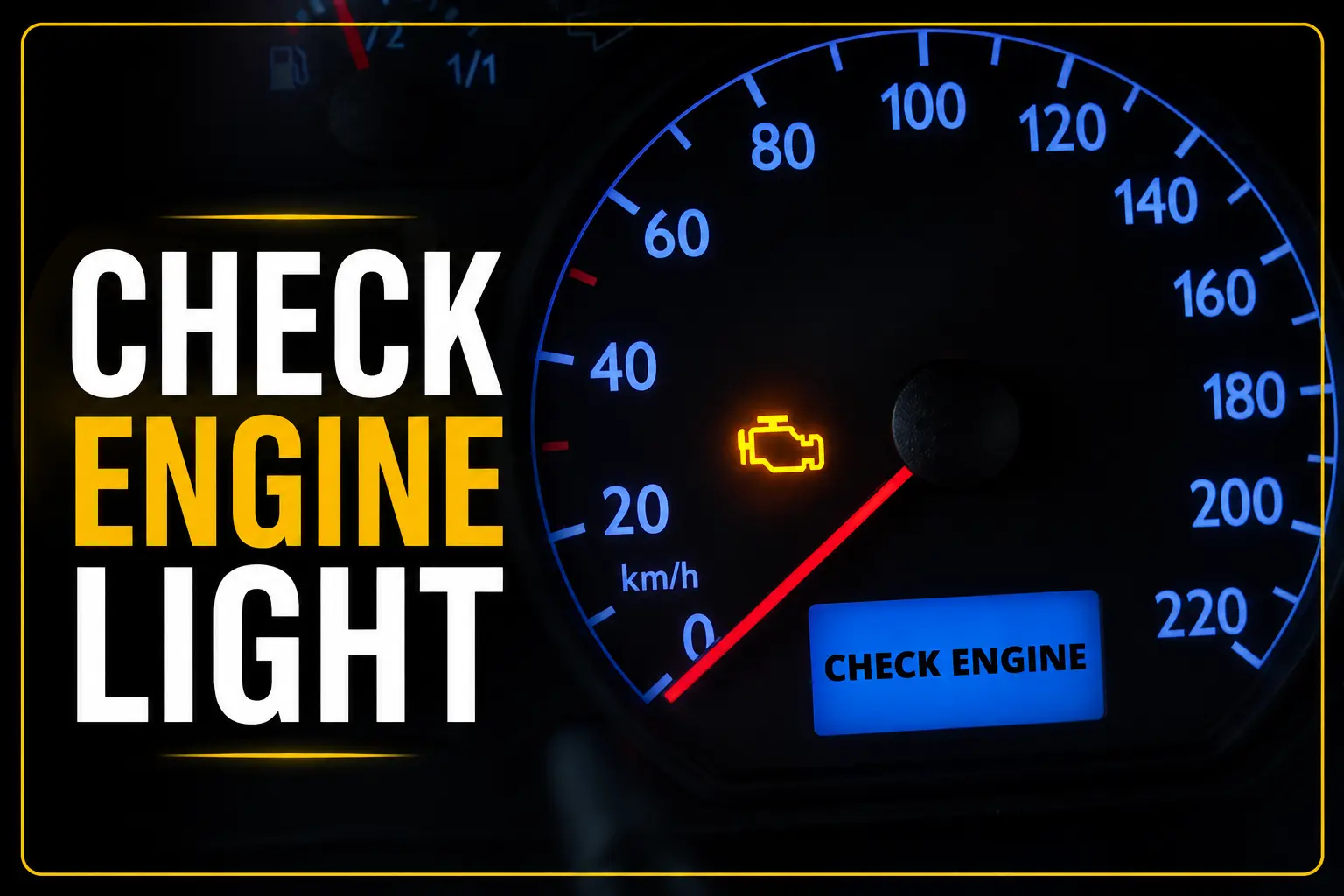
Seeing the Check Engine Light turn on can be frustrating. Sometimes it appears after you start your car; other times, it comes on during a drive without any noticeable changes in performance. Whether the light stays solid or starts flashing, it signals that your vehicle has detected a problem that needs attention.
Modern vehicles constantly monitor the engine, emissions system, fuel delivery, ignition system, and dozens of sensors through the Engine Control Module (ECM) or Powertrain Control Module (PCM). When the system detects a fault outside its normal operating range, it stores a Diagnostic Trouble Code (DTC) in the On-Board Diagnostics II (OBD-II) system. It illuminates the Malfunction Indicator Lamp (MIL), commonly known as the Check Engine Light.
Not every warning means your engine is about to fail. A loose gas cap can trigger the same warning light as a failing oxygen sensor or catalytic converter. However, ignoring the light can turn a small, inexpensive repair into a much larger one.
In this article, you’ll learn what the Check Engine Light means, why it comes on, when it’s safe to keep driving, how to identify the most common causes, and what steps you should take before spending money on repairs.
Quick Answer
The Check Engine Light indicates that your vehicle’s onboard computer has detected a fault affecting the engine, emissions system, fuel system, ignition system, or another monitored component. The computer records a Diagnostic Trouble Code (DTC) that helps identify the problem.
A solid Check Engine Light usually means the issue isn’t immediately damaging, but it should be diagnosed soon.
A flashing Check Engine Light often indicates an active engine misfire that can quickly damage the catalytic converter. In this situation, reduce speed, avoid hard acceleration, and have the vehicle inspected as soon as possible.
Although some causes are minor, such as a loose fuel cap, others can affect engine performance, fuel economy, emissions, and long-term reliability. Reading the stored fault codes with an OBD-II scanner is the fastest way to begin diagnosing the problem.
What Does the Check Engine Light Mean?
The Check Engine Light is one of the most important warning indicators on your dashboard. Unlike an oil pressure warning light or battery warning light, it doesn’t point to one specific failure. Instead, it tells you that your vehicle’s computer has detected an abnormal operating condition.
Every modern vehicle sold since 1996 uses the OBD-II diagnostic system. Hundreds of sensors continuously send information to the Engine Control Module (ECM) or Powertrain Control Module (PCM). These sensors monitor critical systems such as:
- Air intake
- Fuel delivery
- Ignition timing
- Exhaust emissions
- Variable Valve Timing (VVT)
- Engine temperature
- Evaporative emissions (EVAP)
- Transmission operation on many vehicles
The ECM compares incoming sensor data with factory-programmed values. If a sensor reports readings outside the acceptable range for a specific period, the module stores a Diagnostic Trouble Code (DTC) and turns on the Check Engine Light.
For example, if the oxygen sensor consistently detects an incorrect air-fuel mixture, the ECM may store a code related to fuel trim or sensor performance. Likewise, if an ignition coil fails and causes an engine misfire, the computer records the fault and activates the warning light.
The Check Engine Light is not the problem itself, it’s a notification that another component isn’t working as expected.
Why the Light Doesn’t Tell You the Exact Problem
Many drivers expect the warning light to identify the faulty part, but that’s not how the system works.
The ECM detects symptoms rather than visually inspecting components. For example, a lean air-fuel mixture might result from:
- A vacuum leak
- A failing Mass Air Flow (MAF) sensor
- Low fuel pressure
- Dirty fuel injectors
- An intake air leak
Each of these issues can produce similar sensor readings. That’s why technicians don’t replace parts based only on the warning light. Instead, they use:
- An OBD-II scan tool
- Live data
- Freeze-frame data
- Fuel trim readings
- Electrical testing
- Visual inspections
This diagnostic process helps identify the actual root cause instead of replacing parts through guesswork.
How the OBD-II System Detects Problems
Modern vehicles perform thousands of self-checks while you drive.
The ECM constantly evaluates information from multiple sensors, including:
| Component | What It Monitors |
| Oxygen Sensor | Air-fuel mixture in exhaust gases |
| MAF Sensor | Amount of air entering the engine |
| MAP Sensor | Intake manifold pressure |
| Engine Coolant Temperature Sensor | Engine operating temperature |
| Crankshaft Position Sensor | Engine speed and crankshaft position |
| Camshaft Position Sensor | Valve timing synchronization |
| Knock Sensor | Engine knock or detonation |
| EVAP System Sensors | Fuel vapor leaks |
| Fuel Injectors | Fuel delivery performance |
If one sensor reports inconsistent or implausible data compared to the others, the ECM determines whether the fault is temporary or persistent.
If the issue meets the manufacturer’s diagnostic criteria, the system stores:
- A Diagnostic Trouble Code (DTC)
- Freeze-frame data showing engine conditions when the fault occurred
- Readiness monitor information
- Pending or confirmed fault status
Only after these conditions are met does the Check Engine Light illuminate.
What Systems Can Trigger the Check Engine Light?
Many people assume the Check Engine Light only relates to the engine itself. In reality, dozens of interconnected systems can activate the warning.
Understanding these systems makes it easier to appreciate why the same dashboard light can represent very different problems.
Engine Management System
The engine management system controls combustion efficiency, ignition timing, fuel delivery, and overall engine performance.
Common faults include:
- Engine misfires
- Ignition coil failures
- Worn spark plugs
- Incorrect ignition timing
- Compression-related issues
These problems often cause rough idling, hesitation during acceleration, reduced power, and increased fuel consumption.
Fuel System
Your engine relies on precise fuel delivery to maintain the correct air-fuel ratio.
If fuel pressure drops or injectors fail to deliver fuel properly, combustion becomes inefficient.
Potential faults include:
- Dirty fuel injectors
- Weak fuel pump
- Fuel pressure regulator issues
- Restricted fuel filter on applicable vehicles
Fuel system problems often lead to poor acceleration, hard starting, or engine hesitation.
Air Intake System
The engine also depends on accurate airflow measurements.
Sensors like the Mass Air Flow (MAF) sensor and Manifold Absolute Pressure (MAP) sensor help calculate how much fuel should be injected.
Common problems include:
- Dirty MAF sensor
- Intake air leaks
- Vacuum leaks
- Cracked intake hoses
- Sticking throttle body
Because airflow directly affects combustion, even a small leak can trigger a fault code.
Emissions Control System
Many Check Engine Light warnings originate from emissions-related components.
These systems reduce pollutants while ensuring the engine operates efficiently.
Components include:
- Oxygen sensors
- Catalytic converter
- EVAP system
- Purge valve
- Charcoal canister
- Fuel tank pressure sensor
A loose or damaged gas cap can even cause an EVAP leak large enough to illuminate the warning light.
Sensor Network
Modern vehicles rely on dozens of electronic sensors working together.
When one sensor sends inaccurate information, the ECM may compensate temporarily. However, if the readings remain outside expected limits, the Check Engine Light turns on.
Frequently involved sensors include:
- Crankshaft Position Sensor
- Camshaft Position Sensor
- Engine Coolant Temperature Sensor
- Throttle Position Sensor
- Oxygen Sensor
- Knock Sensor
Because these sensors interact with one another, professional diagnosis often involves reviewing live data rather than replacing the first component mentioned by a fault code.
Solid vs. Flashing Check Engine Light
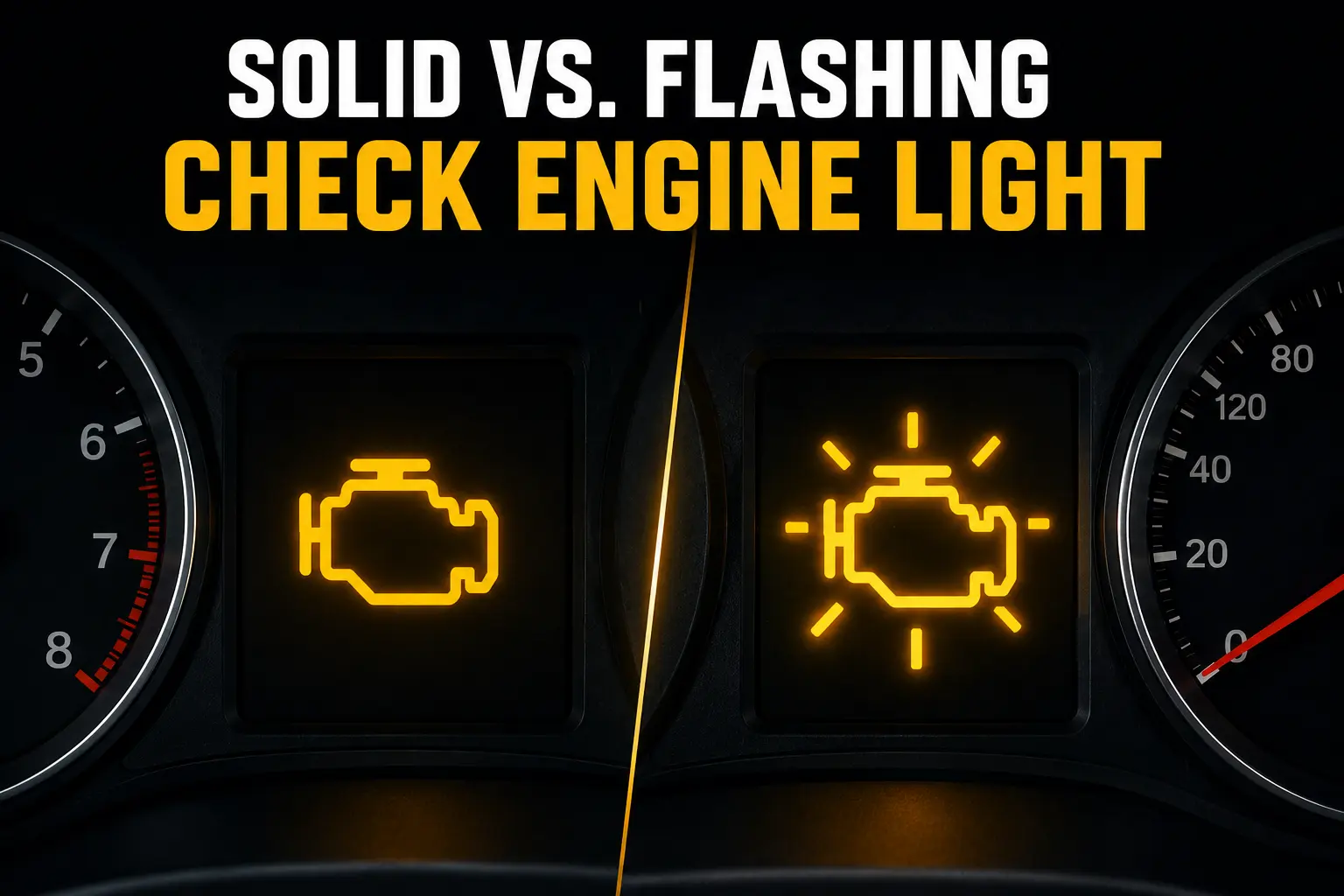
Although both warnings indicate a detected fault, the way the light behaves provides important information about the severity of the problem.
| Check Engine Light | What It Usually Means | Recommended Action |
| Solid | The ECM detected a fault that should be diagnosed soon. The vehicle is often still drivable. | Schedule diagnosis, avoid ignoring the warning. |
| Flashing | An active engine misfire or another severe fault may be occurring. Continued driving can damage the catalytic converter. | Reduce speed immediately and have the vehicle inspected as soon as possible. |
A flashing light should never be ignored. An engine misfire allows unburned fuel to enter the exhaust system, where it can overheat and permanently damage the catalytic converter—a repair that often costs significantly more than fixing the original ignition problem.
Can You Drive With the Check Engine Light On?
A solid Check Engine Light usually means you can drive for a short distance if the car is running normally and there are no serious symptoms such as overheating, shaking, unusual noises, or major power loss. However, you should still diagnose the problem soon.
A flashing Check Engine Light is more urgent and often indicates an active engine misfire. Reduce speed, avoid hard acceleration, and stop driving if the engine is shaking, losing power, overheating, or making unusual noises.
For a complete breakdown of when driving is safe, when you should stop, and how long you may be able to continue, read our guide on Can You Drive With the Check Engine Light On?.
Most Common Causes of a Check Engine Light
A Check Engine Light can illuminate for hundreds of different reasons, but a relatively small group of problems accounts for most cases. Some are inexpensive to fix, while others can lead to serious engine damage if ignored.
The key is understanding why the fault occurs, how it affects your vehicle, and what symptoms usually accompany it. A professional diagnosis always starts with the stored Diagnostic Trouble Codes (DTCs), followed by live data analysis and physical inspection, not by replacing parts based on guesswork.
1. Engine Misfire
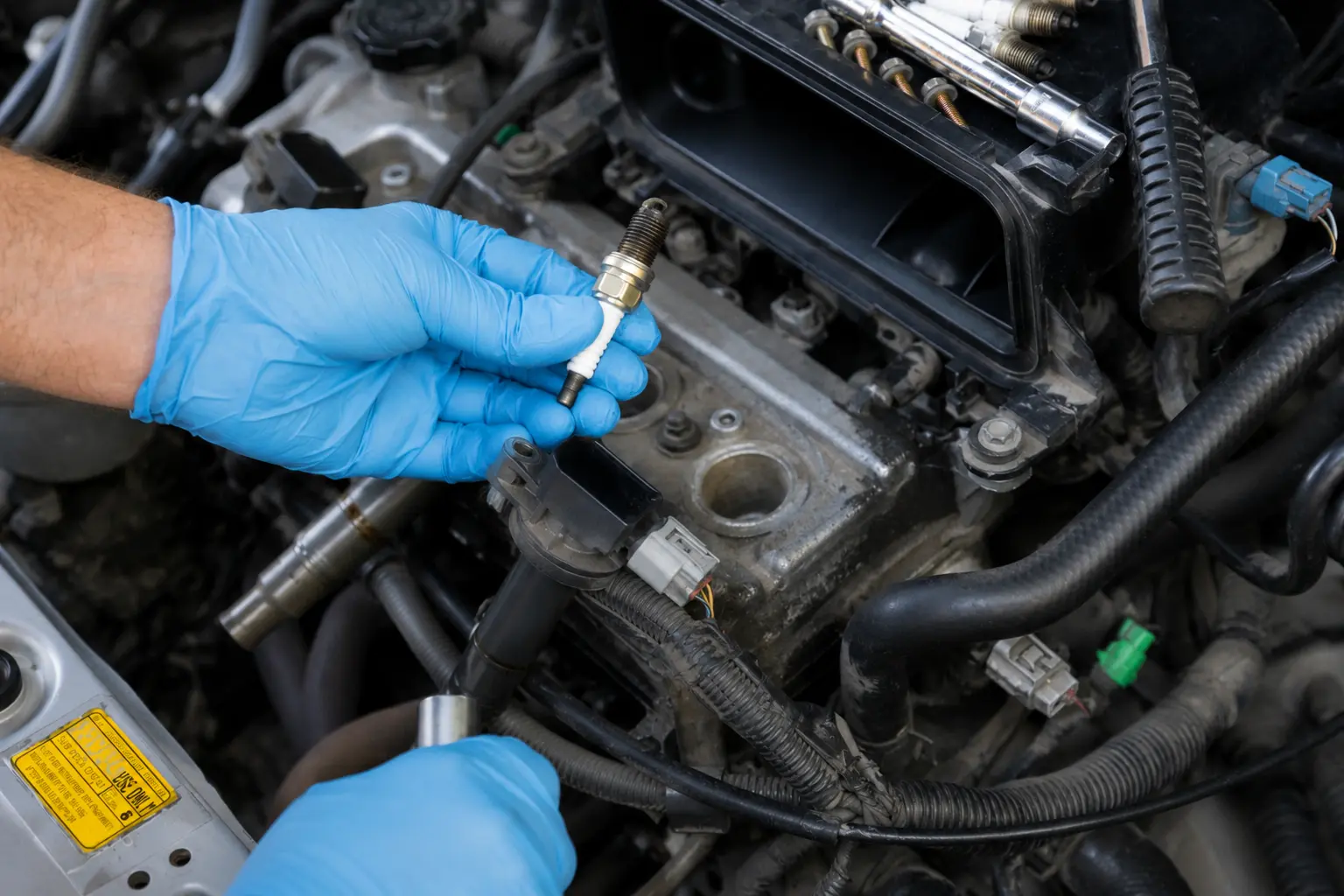
An engine misfire is one of the most common, and potentially most serious reasons for a Check Engine Light. A misfire occurs when one or more cylinders fail to burn the air-fuel mixture correctly, reducing engine efficiency and increasing emissions.
The Engine Control Module (ECM) monitors crankshaft speed through the Crankshaft Position Sensor. If one cylinder contributes less power than expected, the ECM detects irregular crankshaft acceleration and stores a misfire code such as P0300 (random misfire) or P0301–P0308 (specific cylinder).
Common symptoms
- Rough idle
- Engine shaking
- Poor acceleration
- Loss of power
- Reduced fuel economy
- Flashing Check Engine Light
Possible causes
- Worn spark plugs
- Failed ignition coil
- Dirty fuel injector
- Vacuum leak
- Low compression
- Fuel delivery problems
Diagnosis
A technician typically checks:
- Stored DTCs
- Live misfire counters
- Ignition waveform
- Spark plug condition
- Fuel injector operation
- Compression test if necessary
Typical repair cost: $100–$900+, depending on the underlying cause.
Severity: Very High
Driving with an active misfire allows unburned fuel to enter the exhaust, where it can overheat and permanently damage the catalytic converter.
2. Loose or Damaged Gas Cap
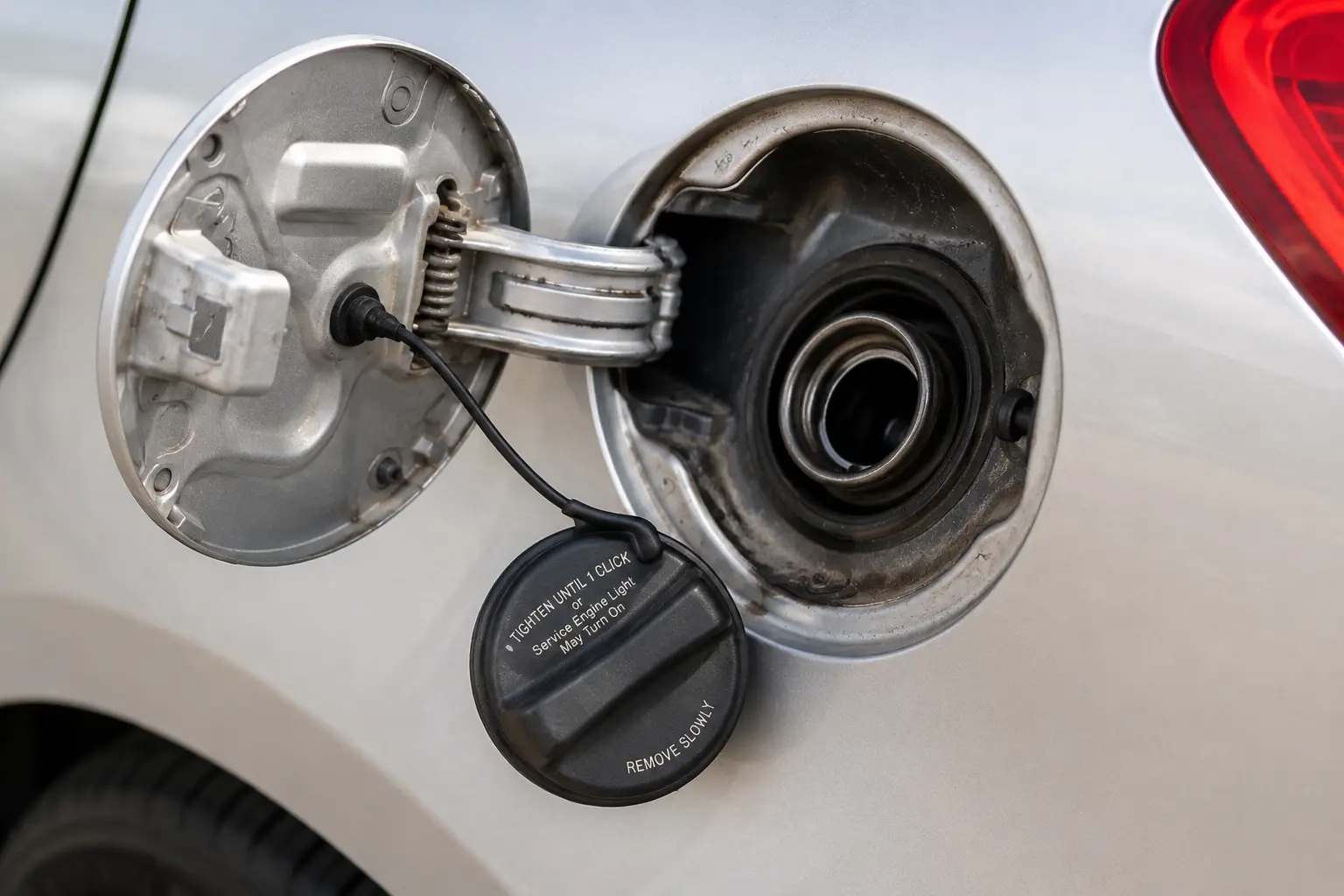
Surprisingly, something as simple as a loose gas cap can trigger the Check Engine Light.
The fuel tank is part of the vehicle’s Evaporative Emission Control (EVAP) System, which prevents gasoline vapors from escaping into the atmosphere. If the gas cap isn’t tightened properly or its rubber seal becomes damaged, the ECM may detect a pressure leak during its EVAP self-test.
Common DTCs include:
- P0455
- P0456
- P0457
Common symptoms
- Check Engine Light only
- Fuel smell near the vehicle (sometimes)
- No noticeable change in engine performance
Diagnosis
The technician checks:
- Gas cap seal
- Fuel filler neck
- EVAP leak test
- Smoke machine inspection if necessary
Typical repair cost: Free to $40
Severity: Low
Always tighten the gas cap until it clicks several times. If the seal is cracked or worn, replacing the cap is inexpensive and often resolves the issue after several normal drive cycles.
3. Faulty Oxygen Sensor (O₂ Sensor)
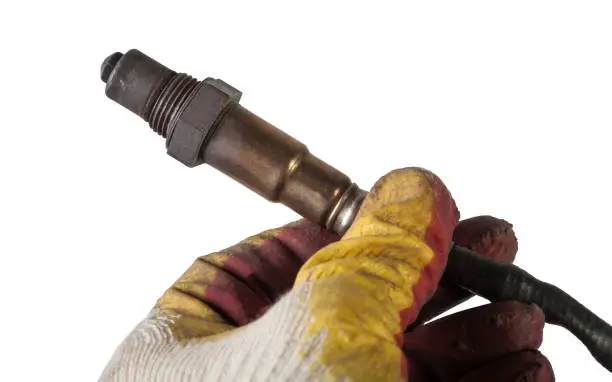
The oxygen sensor, also called the O₂ sensor or Air/Fuel Ratio Sensor on some vehicles, measures the amount of oxygen remaining in the exhaust gases.
The ECM uses this information to continuously adjust the air-fuel ratio, helping maintain efficient combustion while reducing emissions.
When the sensor responds slowly, becomes contaminated, or fails, the ECM can no longer make accurate fuel corrections. This often results in increased fuel consumption and higher exhaust emissions.
Common symptoms
- Check Engine Light
- Poor fuel economy
- Rough idle
- Failed emissions inspection
- Slight hesitation
Diagnosis
Diagnosis usually includes:
- Live sensor voltage
- Fuel trim analysis (STFT and LTFT)
- Exhaust leak inspection
- Wiring inspection
Typical repair cost: $150–$450
Severity: Medium
Ignoring a failed oxygen sensor can eventually shorten the life of the catalytic converter because the engine may run excessively rich or lean.
4. Failing Catalytic Converter
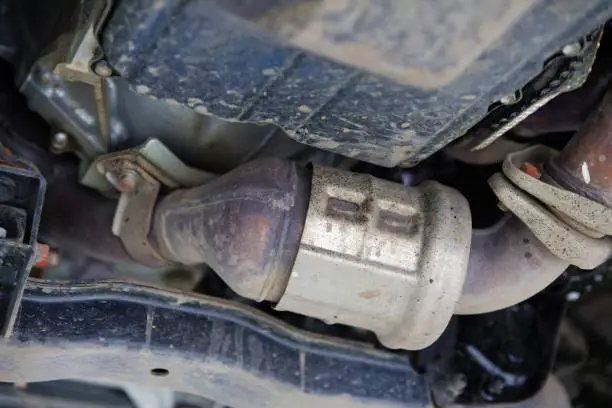
The catalytic converter converts harmful exhaust gases into less harmful emissions before they leave the tailpipe.
When it becomes restricted, contaminated, or internally damaged, exhaust flow decreases, engine performance suffers, and the ECM detects reduced catalyst efficiency.
One of the most common codes is:
P0420 – Catalyst System Efficiency Below Threshold
Common symptoms
- Poor acceleration
- Reduced engine power
- Rotten egg smell
- Higher fuel consumption
- Failed emissions test
Diagnosis
Technicians often compare:
- Upstream oxygen sensor data
- Downstream oxygen sensor data
- Exhaust back pressure
- Exhaust temperature
- Live catalyst efficiency readings
Typical repair cost: $700–$2,500+
Severity: High
Replacing a catalytic converter without fixing the original cause—such as an engine misfire or faulty oxygen sensor—often leads to repeat failures.
5. Dirty or Faulty Mass Air Flow (MAF) Sensor
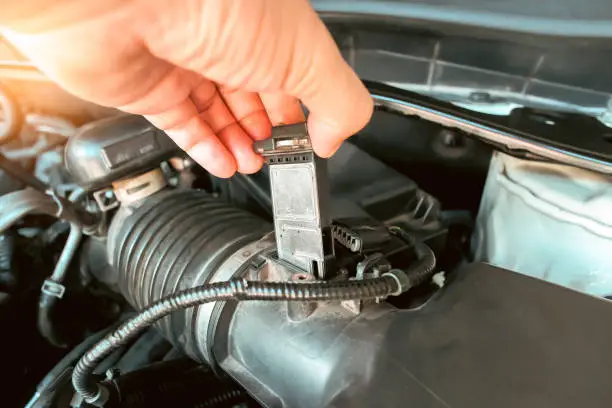
The Mass Air Flow (MAF) sensor measures the amount of air entering the engine.
The ECM relies on this information to calculate the correct amount of fuel to inject during combustion.
If the sensor becomes contaminated with dust or oil residue, airflow readings become inaccurate.
Common symptoms
- Hesitation during acceleration
- Rough idle
- Engine stalling
- Poor fuel economy
- Reduced engine performance
Diagnosis
Diagnosis includes:
- Live airflow readings
- Fuel trim values
- Intake leak inspection
- Sensor cleaning or testing
Typical repair cost: $120–$450
Severity: Medium
Many contaminated MAF sensors can be cleaned using a dedicated Mass Air Flow Sensor Cleaner, although replacement is sometimes necessary.
6. Worn Spark Plugs
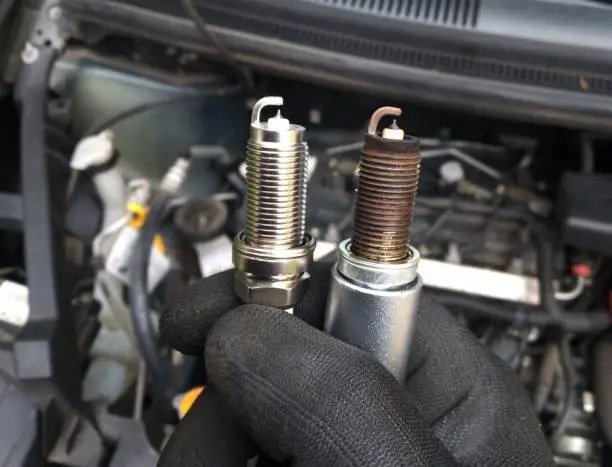
Spark plugs ignite the compressed air-fuel mixture inside each cylinder.
Over time, the electrodes wear, increasing the voltage required to produce a spark. Eventually, combustion becomes inconsistent, leading to engine misfires and poor performance.
Common symptoms
- Hard starting
- Rough idle
- Misfires
- Poor acceleration
- Increased fuel consumption
Diagnosis
Inspection focuses on:
- Electrode wear
- Carbon deposits
- Plug gap
- Heat damage
- Oil fouling
Typical repair cost: $100–$350
Severity: Medium
Replacing spark plugs at the manufacturer’s recommended interval helps prevent ignition-related problems before they trigger the Check Engine Light.
7. Failed Ignition Coil
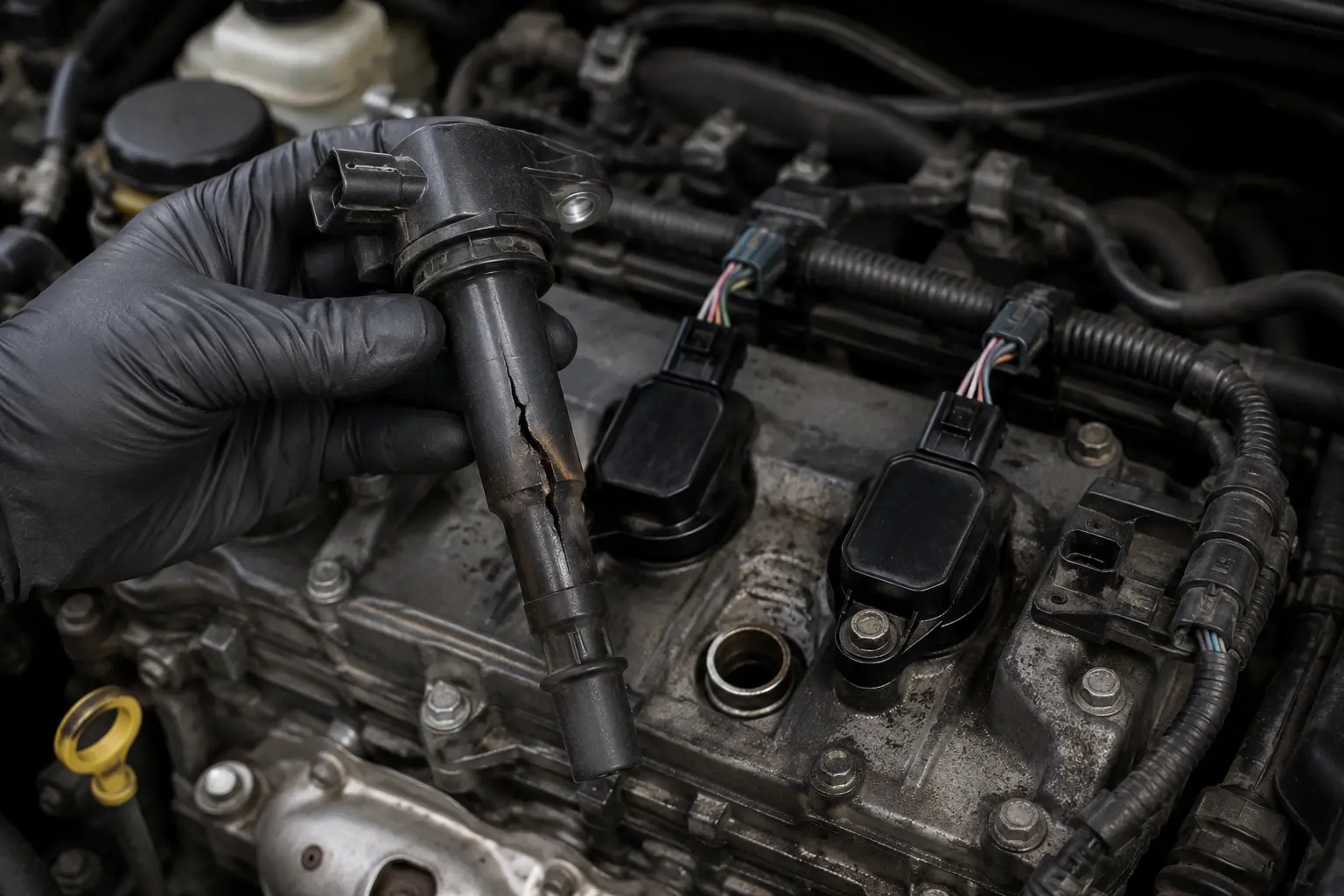
Each ignition coil converts the battery’s low voltage into the high voltage needed for the spark plugs.
When a coil begins to fail, one cylinder may stop firing correctly, causing an engine misfire.
Unlike worn spark plugs, ignition coil failures often appear suddenly.
Common symptoms
- Flashing Check Engine Light
- Rough idle
- Engine shaking
- Loss of power
- Hard acceleration problems
Diagnosis
Technicians verify the problem using:
- Misfire counters
- Coil swap testing
- Oscilloscope testing
- Ignition waveform analysis
Typical repair cost: $180–$600
Severity: High
Driving with a failed ignition coil can quickly damage the catalytic converter because unburned fuel enters the exhaust system.
8. Vacuum Leak
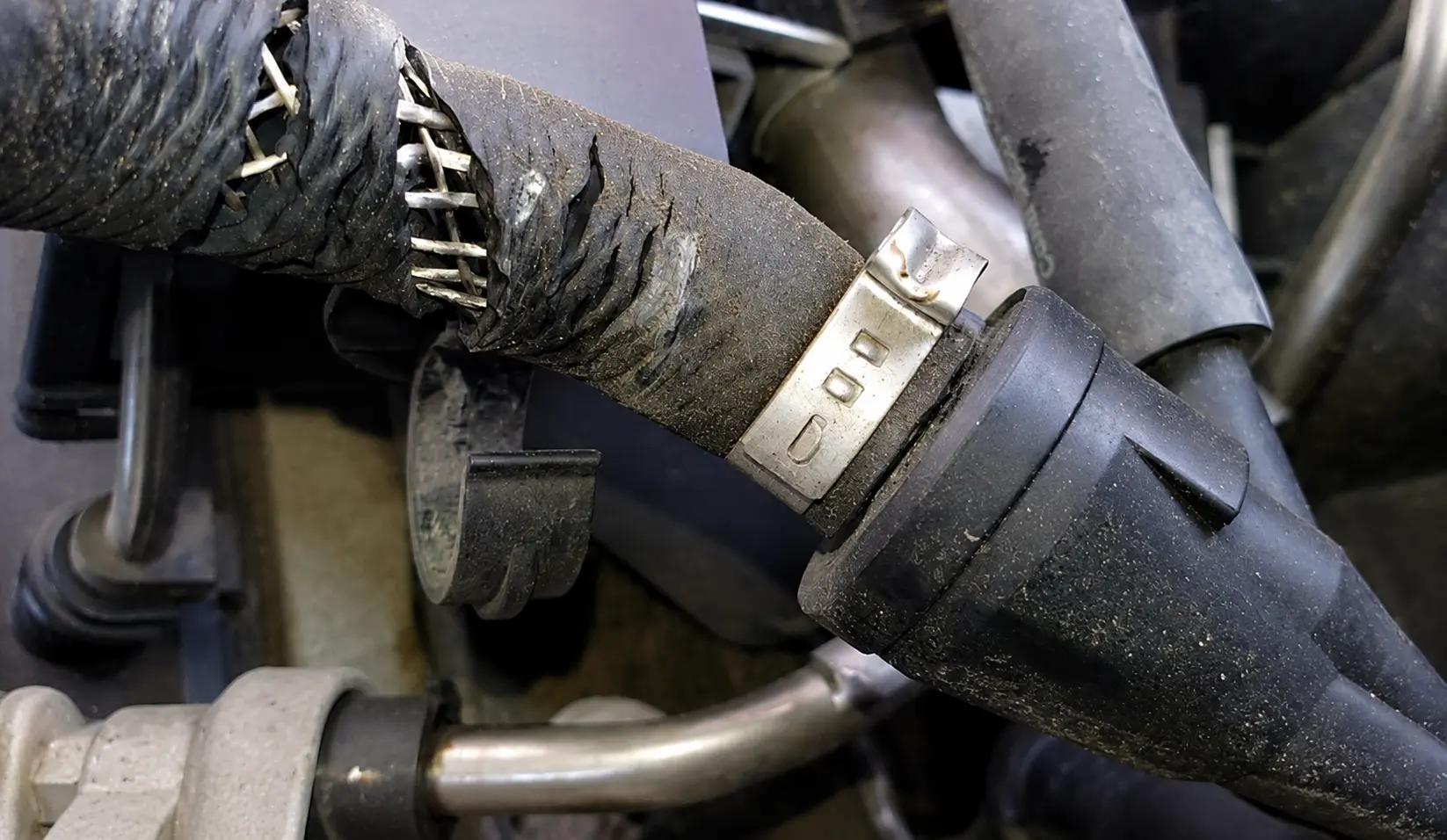
Your engine depends on a sealed intake system to maintain the correct air-fuel mixture.
A vacuum leak allows unmetered air to enter the engine after the MAF sensor, causing the mixture to become lean.
The ECM attempts to compensate by increasing fuel delivery through Short-Term Fuel Trim (STFT) and Long-Term Fuel Trim (LTFT). When these corrections exceed acceptable limits, the Check Engine Light illuminates.
Common symptoms
- High idle speed
- Rough idle
- Hesitation
- Whistling noise
- Lean condition fault codes
- Poor fuel economy
Common leak locations
- Intake manifold gasket
- Vacuum hoses
- PCV valve
- Brake booster hose
- Throttle body gasket
Diagnosis
Technicians often use:
- Smoke machine testing
- Fuel trim analysis
- Intake leak inspection
- Carburetor cleaner test (where appropriate)
Typical repair cost: $100–$500
Severity: Medium
Even a small vacuum leak can significantly affect drivability and fuel economy, making early diagnosis worthwhile.
Diagnose the Problem by Your Symptoms
The Check Engine Light tells you that the Engine Control Module (ECM) has detected a fault, but it doesn’t explain how that problem affects your vehicle. Paying attention to the symptoms you’re experiencing can help narrow down the possible causes before you even connect an OBD-II scanner.
Remember that the symptom alone doesn’t confirm a faulty part. The ECM stores Diagnostic Trouble Codes (DTCs) based on abnormal sensor readings, while a technician combines those codes with live data, freeze-frame data, and physical testing to identify the actual problem.
Check Engine Light + Rough Idle
If your engine shakes while idling or the RPM fluctuates at a stoplight, combustion is usually becoming unstable.
Possible causes include:
- Engine misfire
- Worn spark plugs
- Faulty ignition coil
- Dirty fuel injectors
- Vacuum leak
- Dirty throttle body
- Failing MAF sensor
The engine may still drive normally at higher speeds because airflow increases, masking the problem.
Check Engine Light + Traction Control Light
If the Check Engine Light and traction control light appear together, an engine or electronic control fault may cause the vehicle to limit traction-control operation. See the common causes and troubleshooting steps in our guide to the Check Engine Light and Traction Control Light on together.
Check Engine Light + Loss of Power
If the vehicle struggles to accelerate or feels sluggish, the engine may not be producing its normal power.
Common causes include:
- Restricted catalytic converter
- Engine misfire
- Fuel delivery problems
- MAF sensor failure
- MAP sensor failure
- Variable Valve Timing (VVT) issues
Some vehicles may also enter Limp Mode, where the ECM intentionally limits engine power to protect critical components from further damage.
Check Engine Light + Poor Fuel Economy
A sudden drop in fuel mileage usually means the engine is no longer maintaining the ideal air-fuel ratio.
Possible causes include:
- Oxygen sensor failure
- Dirty MAF sensor
- Vacuum leak
- Fuel injector problems
- Stuck thermostat
- Engine Coolant Temperature (ECT) sensor failure
The ECM attempts to compensate using Short-Term Fuel Trim (STFT) and Long-Term Fuel Trim (LTFT). Excessive fuel trim corrections often indicate an underlying issue that requires diagnosis.
Check Engine Light + Hard Starting
If the engine cranks longer than usual before starting—or occasionally refuses to start—the problem may involve ignition timing, fuel delivery, or sensor input.
Possible causes include:
- Weak fuel pump
- Camshaft Position Sensor
- Crankshaft Position Sensor
- Ignition system failure
- Fuel pressure issues
These problems often become worse in cold weather or after the vehicle has been sitting overnight.
Check Engine Light + Engine Stalling
An engine that stalls while driving or at idle should never be ignored.
Possible causes include:
- Dirty throttle body
- Failing crankshaft sensor
- Fuel pump failure
- Ignition failure
- Severe vacuum leak
Because stalling can occur unexpectedly, this symptom deserves immediate diagnosis.
Check Engine Light + Fuel Smell
A noticeable gasoline smell often indicates a problem with the fuel or emissions system.
Possible causes include:
- EVAP leak
- Loose gas cap
- Damaged purge valve
- Fuel injector leak
- Fuel line leak
Besides triggering the Check Engine Light, these issues can increase emissions and create a potential fire hazard.
Check Engine Light + Black Smoke
Black smoke usually indicates that the engine is running rich.
Common causes include:
- Faulty oxygen sensor
- Dirty MAF sensor
- Leaking fuel injector
- High fuel pressure
- EVAP purge valve stuck open
Rich fuel mixtures reduce fuel economy and may eventually damage the catalytic converter.
Check Engine Light + White Smoke
White smoke can have several causes depending on its appearance.
Thin white vapor during cold weather is usually normal condensation.
Continuous thick white smoke may indicate:
- Coolant entering the combustion chamber
- Head gasket failure
- Cracked cylinder head
These are serious mechanical issues that require immediate inspection.
Check Engine Light + Flashing Light
A flashing Check Engine Light is one of the most urgent dashboard warnings.
It almost always indicates an active engine misfire severe enough to damage the catalytic converter.
If the light begins flashing:
- Reduce speed immediately.
- Avoid heavy acceleration.
- Avoid towing.
- Have the vehicle diagnosed as soon as possible.
Continuing to drive can turn a relatively inexpensive ignition repair into a catalytic converter replacement costing thousands of dollars.
Understanding OBD-II Codes
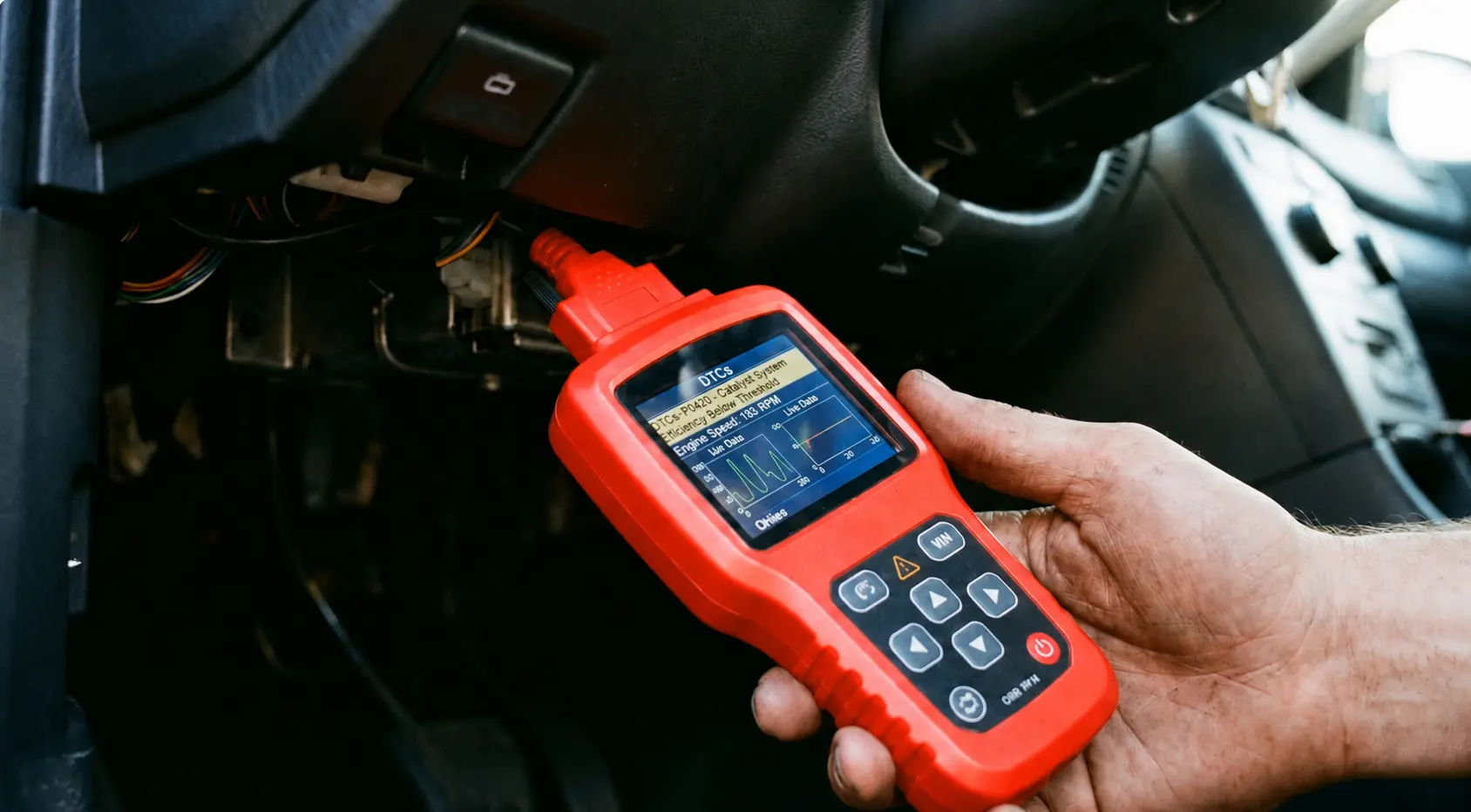
The On-Board Diagnostics II (OBD-II) system standardizes vehicle diagnostics across nearly every modern gasoline-powered vehicle.
When the ECM detects an abnormal condition, it stores a Diagnostic Trouble Code (DTC) that technicians retrieve using a compatible scan tool.
These codes don’t identify the exact failed component. Instead, they identify the system where the fault occurred.
For example, a lean fuel mixture code doesn’t necessarily mean the oxygen sensor is bad. The actual problem could be:
- Vacuum leak
- Dirty MAF sensor
- Low fuel pressure
- Intake air leak
- Exhaust leak
This is why experienced technicians never replace parts based solely on a fault code.
Types of Diagnostic Trouble Codes
Pending Codes
A pending code means the ECM has detected an abnormal condition once but hasn’t confirmed the fault.
If the problem disappears during later drive cycles, the pending code may clear itself.
Confirmed Codes
When the same fault occurs repeatedly, the ECM stores a confirmed code and illuminates the Check Engine Light.
These are the codes most technicians begin diagnosing.
Permanent Codes
Permanent codes remain stored even after clearing codes with a scan tool.
They disappear only after the ECM verifies that the repair has been completed successfully during multiple drive cycles.
Freeze-Frame Data
Whenever a significant fault occurs, the ECM records freeze-frame data, which acts like a snapshot of engine operating conditions.
It typically includes:
- Engine RPM
- Vehicle speed
- Engine load
- Coolant temperature
- Fuel trims
- Intake air temperature
- Throttle position
Freeze-frame information helps technicians recreate the conditions under which the fault occurred.
Live Data
Unlike stored fault codes, live data shows what sensors are reporting in real time.
Professional technicians often review:
- Oxygen sensor activity
- Fuel trims
- Engine coolant temperature
- MAF readings
- MAP readings
- Ignition timing
- Throttle position
Live data frequently reveals problems that stored codes alone cannot explain.
Typical Check Engine Light Repair Costs
Repair costs vary depending on the failed component, labor rates, and vehicle model.
| Problem | Estimated Repair Cost |
| Tighten or replace gas cap | $0–$40 |
| Spark plugs | $100–$350 |
| Ignition coil | $180–$600 |
| Oxygen sensor | $150–$450 |
| MAF sensor | $120–$450 |
| Vacuum leak | $100–$500 |
| Fuel injector | $250–$900 |
| EVAP purge valve | $150–$450 |
| Camshaft sensor | $150–$450 |
| Crankshaft sensor | $180–$500 |
| Fuel pump | $500–$1,400 |
| Catalytic converter | $700–$2,500+ |
These are general estimates. Luxury vehicles, turbocharged engines, and hybrid powertrains often cost more to repair.
Situation-Based Troubleshooting
Certain situations cause drivers to panic because the Check Engine Light appears immediately after maintenance or under unusual conditions. In many cases, the timing is coincidental, but it’s worth investigating.
Check Engine Light Comes On and Goes Off
If the Check Engine Light turns on and later disappears, the fault may be intermittent rather than permanently resolved. Learn why this happens and what to check in our guide to an intermittent Check Engine Light.
Check Engine Light After an Oil Change
If the warning appears shortly after an oil change, first inspect the basics.
Check that:
- The oil filler cap is installed correctly.
- The dipstick is fully seated.
- No electrical connectors were accidentally disconnected.
- The engine contains the correct oil level and viscosity.
If the warning appeared immediately after service, see our complete guide to the Check Engine Light after an oil change for the possible causes and troubleshooting steps.
Check Engine Light After Replacing the Battery
Disconnecting the battery resets portions of the ECM’s adaptive memory.
After reconnection, the vehicle must complete several drive cycles before all readiness monitors finish testing.
If the light returns, retrieve the stored DTCs rather than assuming the battery caused the problem.
If the warning appeared immediately after installing a new batteryCan You Drive With the Check Engine Light On, see our complete article to the Check Engine Light after battery replacement.
Check Engine Light After Filling the Gas Tank
This situation commonly points toward the EVAP system.
Possible causes include:
- Loose gas cap
- Damaged gas cap seal
- Faulty purge valve
- EVAP leak
- Fuel tank pressure sensor issue
Simply tightening the gas cap may resolve the issue after several normal drive cycles if no other faults are present.
If the warning appeared shortly after refueling, see our complete guide to the Check Engine Light after getting gas for the most likely causes and what to check first.
Check Engine Light After Driving Through Heavy Rain
Water intrusion can temporarily affect electrical connectors, ignition components, or exposed sensors.
If the light disappears after everything dries, the problem may have been temporary.
However, if the warning remains, inspect:
- Ignition coils
- Spark plug wells
- Wiring connectors
- Air intake system
Moisture-related faults should never be ignored because repeated water intrusion can damage electrical components.
How to Reset the Check Engine Light
The Check Engine Light should only be reset after the underlying problem has been repaired. Clearing the light without fixing the fault is only temporary because the ECM will detect the issue again and turn the warning light back on.
You can reset the light by:
- Repairing the fault – In most cases, the light turns off automatically after the vehicle completes a few successful drive cycles.
- Using an OBD-II scanner – After repairs, erase the stored Diagnostic Trouble Codes (DTCs) with a scan tool.
- Letting the ECM clear it naturally – Some issues, such as a loose gas cap, may clear on their own after several normal drive cycles.
Want the complete step-by-step process? Read our detailed guide on How to Reset the Check Engine Light.
Avoid These Common Mistakes
Some drivers disconnect the battery to erase the Check Engine Light.
Although this may temporarily remove the warning, it also resets adaptive memory and emission readiness monitors. On many vehicles, the light will return if the original problem still exists.
Likewise, repeatedly clearing codes without diagnosing the fault only hides valuable information that technicians use during troubleshooting, including freeze-frame data and stored DTCs.
DIY or Visit a Mechanic?
Some Check Engine Light problems are simple enough for experienced DIYers, while others require professional diagnostic equipment.
Knowing the difference can save both time and money.
| DIY-Friendly Repairs | Repairs Best Left to a Professional |
| Tighten or replace gas cap | Catalytic converter replacement |
| Replace engine air filter | Internal engine repairs |
| Replace spark plugs (on accessible engines) | Fuel pressure diagnosis |
| Clean the MAF sensor | Compression testing |
| Replace accessible ignition coils | Oscilloscope electrical testing |
| Read OBD-II codes | Advanced ECM diagnostics |
If you’re comfortable performing basic maintenance and have access to an OBD-II scanner, you may be able to identify simple problems yourself.
However, professional diagnosis becomes important when:
- Multiple fault codes appear at the same time.
- The engine misfires continuously.
- The vehicle enters Limp Mode.
- The Check Engine Light flashes.
- The engine overheats.
- The vehicle stalls unexpectedly.
- You notice knocking noises or severe vibration.
Modern vehicles use complex electronic systems, and replacing parts without proper testing often increases repair costs instead of solving the problem.
Final Thoughts
The Check Engine Light is more than just another dashboard warning—it is your vehicle’s way of telling you that something within the engine management or emissions system requires attention.
In many cases, the problem may be as simple as a loose gas cap or a contaminated Mass Air Flow (MAF) sensor. In others, it could involve a failing oxygen sensor, an engine misfire, fuel delivery issues, or a restricted catalytic converter. Because the same warning light can represent many different faults, relying on assumptions or replacing parts at random often leads to unnecessary expense.
The smartest approach is to retrieve the stored Diagnostic Trouble Codes (DTCs) with an OBD-II scanner, review the symptoms, and diagnose the root cause before making repairs. Combining fault codes with live data, freeze-frame data, and a systematic inspection provides a far more accurate diagnosis than guessing based on the warning light alone.
Addressing a Check Engine Light promptly helps maintain engine performance, improve fuel efficiency, reduce emissions, and prevent minor issues from developing into major repairs. Whether you handle basic maintenance yourself or seek professional assistance, early diagnosis is almost always the most cost-effective solution.
Frequently Asked Questions
Why is my Check Engine Light on but the car runs fine?
Many emission-related faults don’t immediately affect how the vehicle drives. Problems such as a loose gas cap, EVAP leak, or failing oxygen sensor may trigger the warning light long before noticeable performance issues develop. Even if the vehicle feels normal, you should still scan for Diagnostic Trouble Codes to identify the cause.
Can a low battery cause the Check Engine Light?
Yes. A weak or failing battery can create unstable system voltage, which may affect electronic modules and sensors. However, the battery is rarely the direct cause of a persistent Check Engine Light. If the warning remains after charging or replacing the battery, retrieve the stored fault codes for further diagnosis.
Will the Check Engine Light turn off by itself?
Yes, in some situations. Once the underlying problem has been repaired, the ECM may switch the light off automatically after several successful drive cycles. The exact number varies by manufacturer and the type of fault.
Is it safe to drive with the Check Engine Light on?
A solid Check Engine Light often allows short-term driving if the vehicle runs normally and no other warning lights appear. A flashing Check Engine Light, however, usually indicates an active engine misfire that requires immediate attention because it can damage the catalytic converter.
Can an oil change cause the Check Engine Light?
An oil change itself usually does not trigger the warning. However, forgetting to reinstall the oil filler cap, disconnecting a sensor, or using the incorrect oil specification may contribute to engine-related faults that activate the light.
Can bad spark plugs trigger the Check Engine Light?
Yes. Worn spark plugs can cause engine misfires, rough idling, poor acceleration, and reduced fuel economy. The ECM detects these misfires and stores corresponding DTCs before illuminating the Check Engine Light.
How much does it cost to diagnose a Check Engine Light?
Many auto parts stores offer free code scanning, although this only retrieves Diagnostic Trouble Codes. A professional diagnostic service typically costs between $80 and $200, depending on the shop, vehicle, and testing required. Advanced diagnostics involving electrical testing, smoke testing, or live data analysis may cost more.
Can I ignore the Check Engine Light?
Ignoring the warning is never recommended. While some problems are relatively minor, others—such as engine misfires or catalytic converter failures—can become much more expensive if left unresolved. Diagnosing the issue early often prevents additional damage and reduces repair costs.