
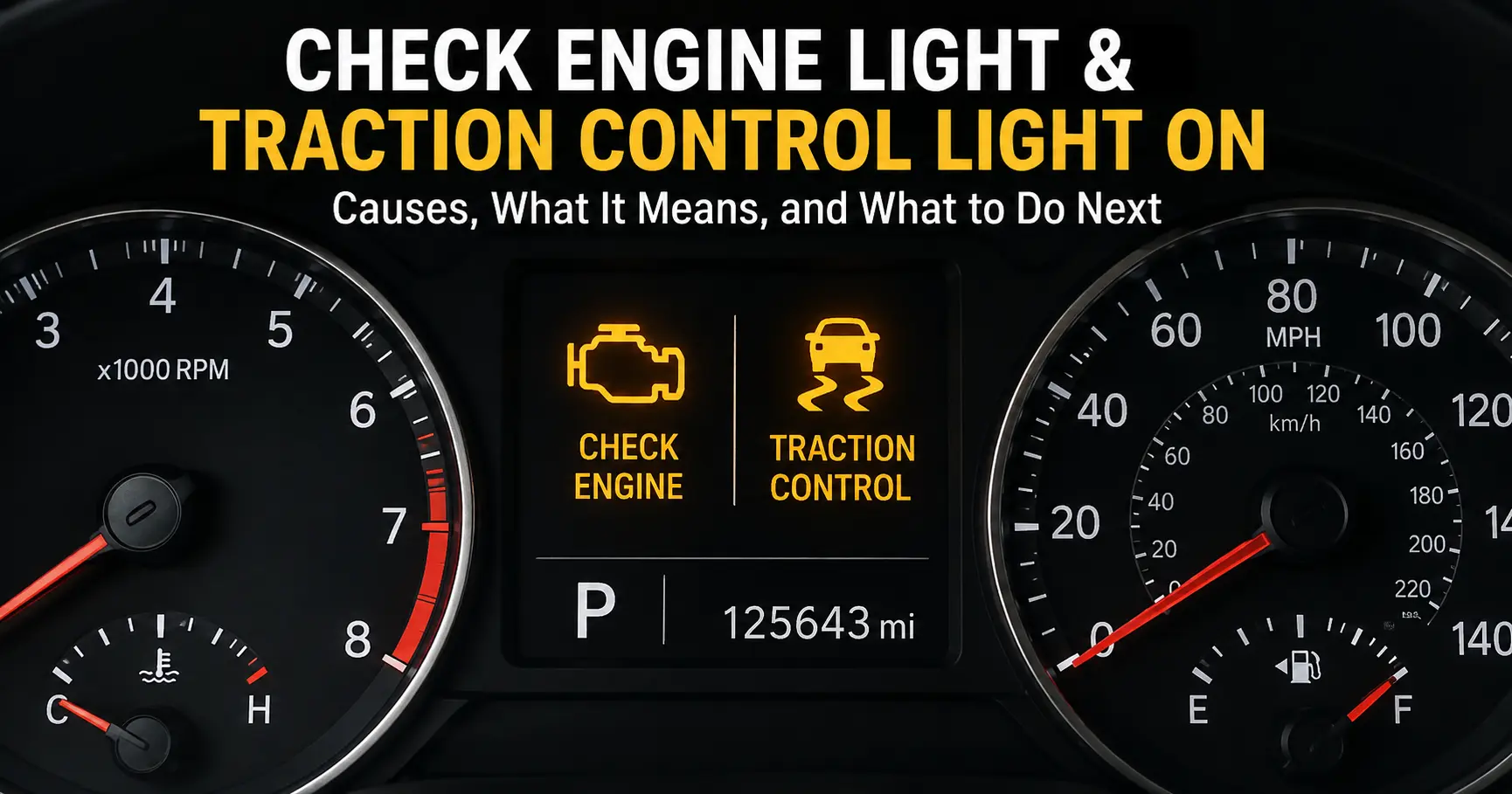
If your check engine light and traction control light are on at the same time, you may not have two separate problems. On many vehicles, an engine or powertrain fault can cause the ECM/PCM to disable traction or stability control because it can no longer manage engine torque reliably.
Common causes include an engine misfire, electronic throttle problem, wheel-speed sensor fault, air-fuel issue, low system voltage, or damaged wiring. The Check Engine Light can be triggered by many engine, emissions, and sensor-related faults, so the stored trouble code is usually the best clue to where the problem started.
Start by checking how the car runs and whether the Check Engine Light is solid or flashing. Then scan the vehicle for Diagnostic Trouble Codes (DTCs) before replacing parts or clearing the warnings.
Quick Answer: When the Check Engine Light and traction control light come on together, the engine fault may be the primary problem. If the engine runs normally and the Check Engine Light is solid, you can usually drive carefully for a short distance to get it diagnosed. If the Check Engine Light is flashing, the car is shaking, power is severely reduced, or other serious warnings appear, stop driving when it is safe to do so.
Why Are the Check Engine and Traction Control Lights On Together?
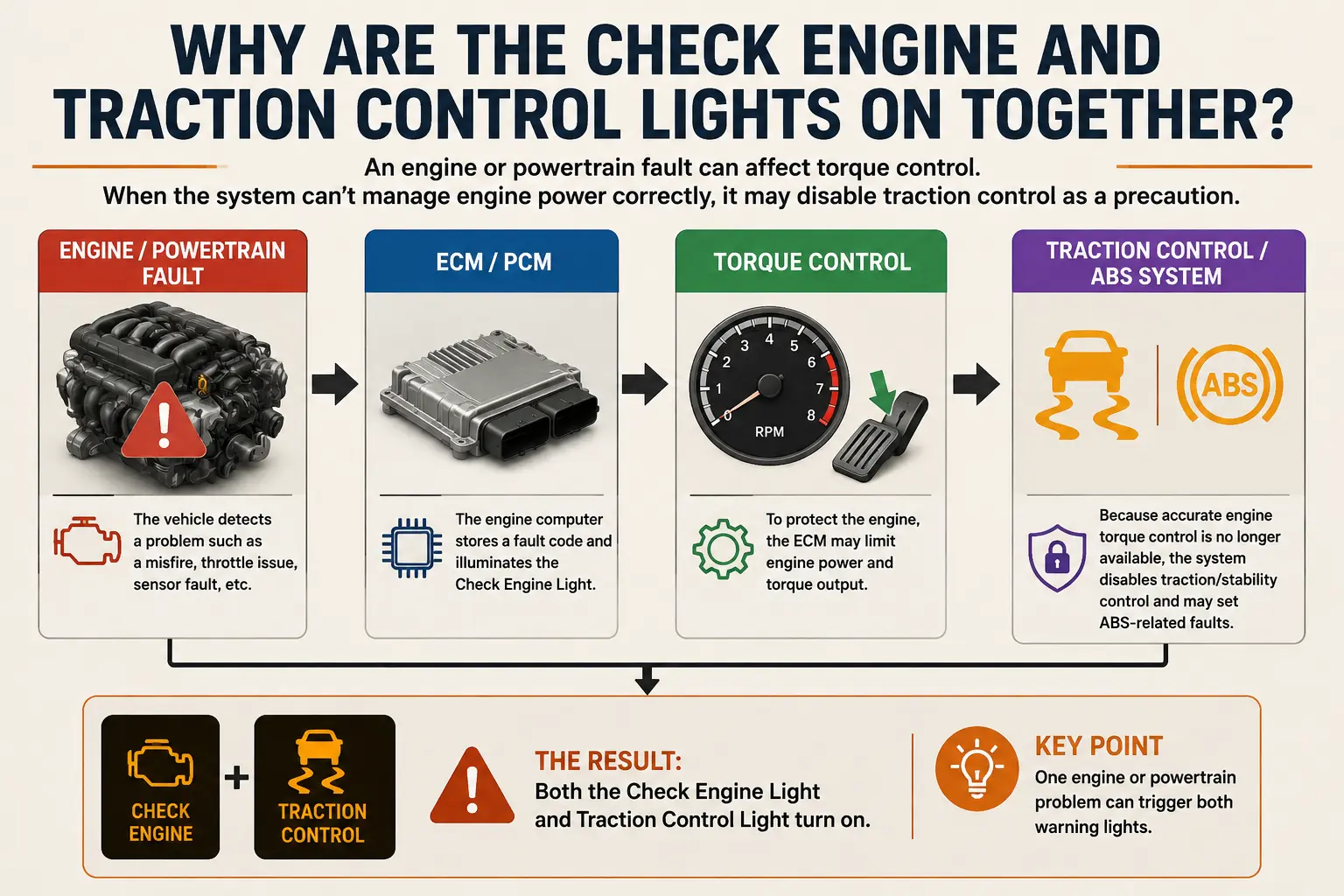
The Traction Control System (TCS) does more than monitor the tires. It works with several systems in your vehicle, including the Anti-lock Braking System (ABS) and engine-management system.
When a driven wheel starts slipping, traction control may apply braking to that wheel and request a reduction in engine torque. The ECM or PCM helps make that torque reduction possible by controlling functions such as throttle opening, fuel delivery, and ignition.
This connection explains why an engine problem can sometimes trigger both warnings.
For example, suppose the PCM detects a serious misfire or an electronic throttle fault. It turns on the Check Engine Light. Because accurate engine torque control may no longer be available, the vehicle may also disable traction or stability control as a precaution.
In that situation, the traction control light does not necessarily mean the traction system itself has failed.
The opposite can also happen. Problems involving wheel-speed information, ABS components, electrical power, or communication between control modules can affect several systems and produce multiple dashboard warnings.
The exact behavior varies by vehicle manufacturer and model, which is why retrieving the stored fault codes is an important first step.
Common Causes of the Check Engine Light and Traction Control Light
There is no single component that causes these two warning lights on every vehicle. The symptoms and stored codes help narrow down the actual problem.
Here are the most relevant areas to investigate.
1. Engine Misfire
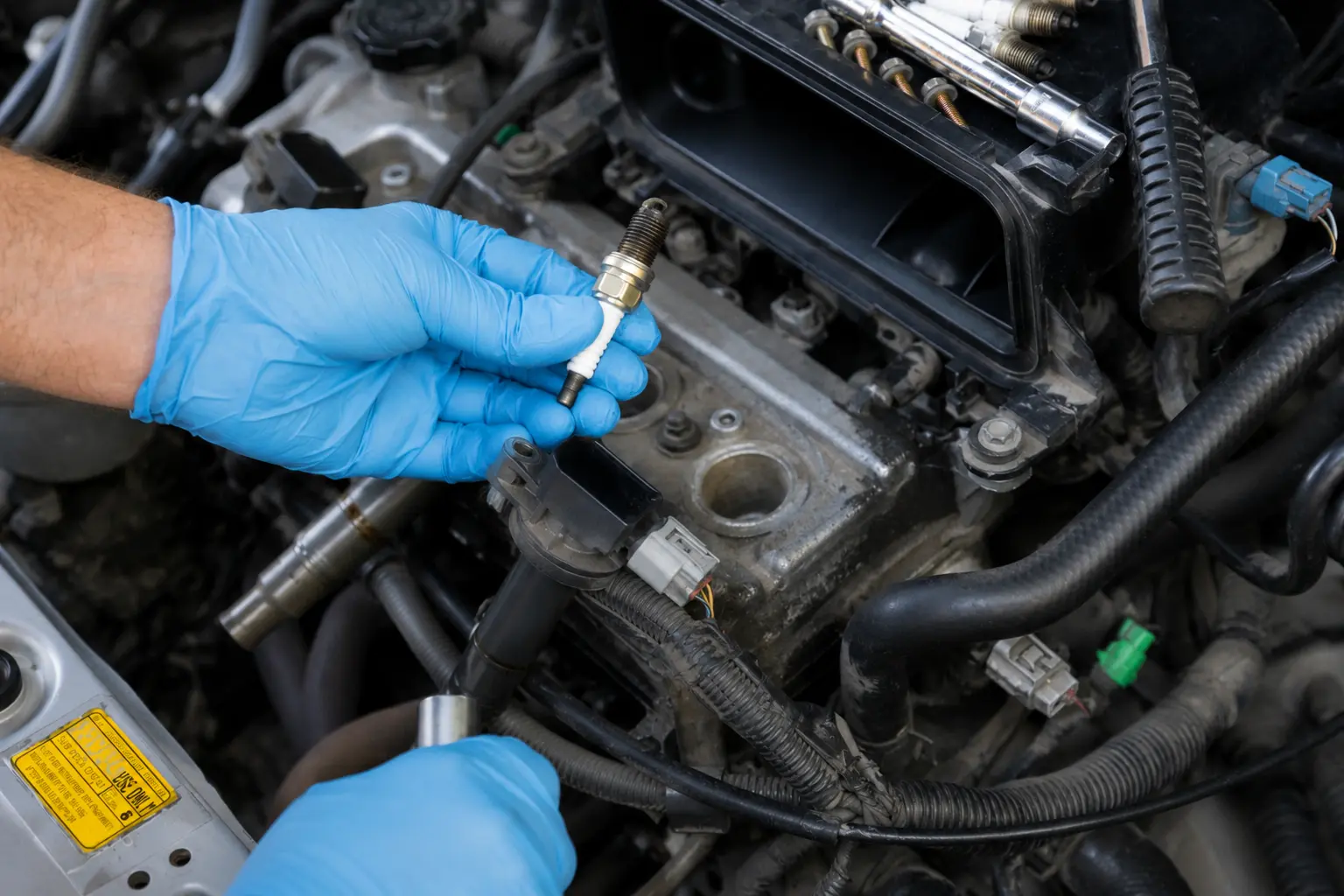
An engine misfire is an important cause to consider, especially if the car shakes, idles roughly, hesitates, or has poor acceleration.
A misfire occurs when one or more cylinders fail to produce power correctly. Possible causes include:
- Worn or damaged spark plugs
- Faulty ignition coils
- Fuel injector problems
- Air or vacuum leaks
- Fuel-delivery problems
- Mechanical engine problems
The PCM monitors crankshaft speed and other operating data to detect misfires. Depending on the vehicle and severity of the fault, it may disable traction or stability functions because engine torque is no longer being produced as expected.
Codes such as P0300 indicate random/multiple-cylinder misfires, while P0301, P0302, and similar codes identify the cylinder where a misfire was detected.
But don’t replace an ignition coil simply because you find a misfire code. The spark plug, injector, wiring, compression, or another problem could be responsible.
What to do: Scan for DTCs and diagnose the affected cylinder or system. If the engine is shaking severely or the Check Engine Light is flashing, stop driving immediately, as an active misfire can overheat and damage the catalytic converter.
2. Electronic Throttle Body or Throttle Position Problem
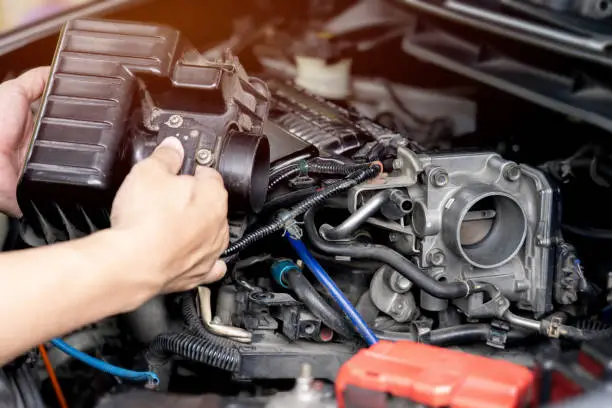
The electronic throttle control (ETC) system is another important connection between the check engine light and traction control system.
Most newer vehicles use an electronically controlled throttle body rather than a simple mechanical throttle cable. The PCM compares signals from components such as the accelerator pedal position sensors and throttle position sensors to determine how far the throttle should open.
Traction and stability systems can also request changes in engine torque.
If the PCM detects conflicting or unreliable throttle information, it may set a fault code, illuminate the Check Engine Light, limit engine power, and disable traction control.
Possible symptoms include:
- Poor throttle response
- Reduced engine power
- Hesitation
- Limited acceleration
- Rough running
- Traction or stability warning messages
Codes such as P0121 or P2135 can point toward throttle-position or correlation problems, but diagnosis may involve the throttle body, sensor circuits, connectors, wiring, or PCM inputs.
What to do: Have the throttle-control system diagnosed using scan data and appropriate electrical tests. If the vehicle enters reduced-power or limp mode, avoid unnecessary driving until the cause is identified.
3. Wheel-Speed Sensor or ABS Fault
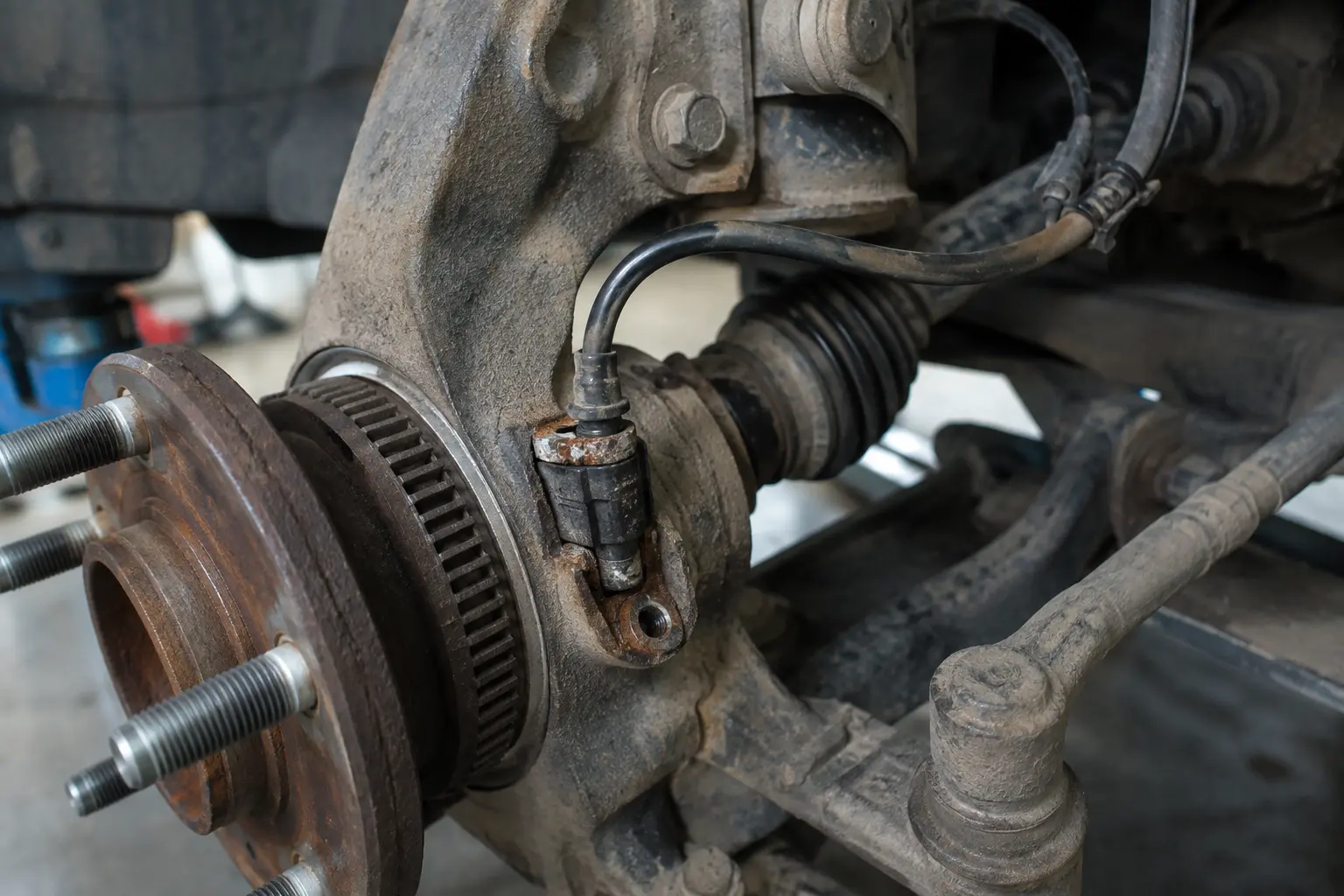
Traction control relies heavily on wheel-speed sensors.
A sensor at each wheel measures rotational speed. The ABS control module compares those signals to determine whether a wheel is locking during braking or spinning during acceleration.
A damaged sensor, corroded connector, broken wire, damaged tone/reluctor ring, or wheel-hub problem can provide inaccurate wheel-speed information.
You may see the:
- Traction control light
- ABS warning light
- Stability control warning
Whether a Check Engine Light also appears depends on the vehicle and the nature of the fault. A wheel-speed sensor problem should therefore not automatically be blamed whenever the traction control and Check Engine Light are on together.
What to do: Scan modules capable of storing ABS/chassis codes, not just basic engine codes. Inspect the affected wheel-speed sensor, wiring, connector, tone ring, and related components before replacing the sensor.
If the engine runs normally but ABS or traction control is disabled, the vehicle may still have conventional braking, but electronic assistance can be reduced. Drive cautiously and get the fault diagnosed soon, especially on wet, icy, or loose roads.
4. Airflow, Vacuum, or Air-Fuel Problem
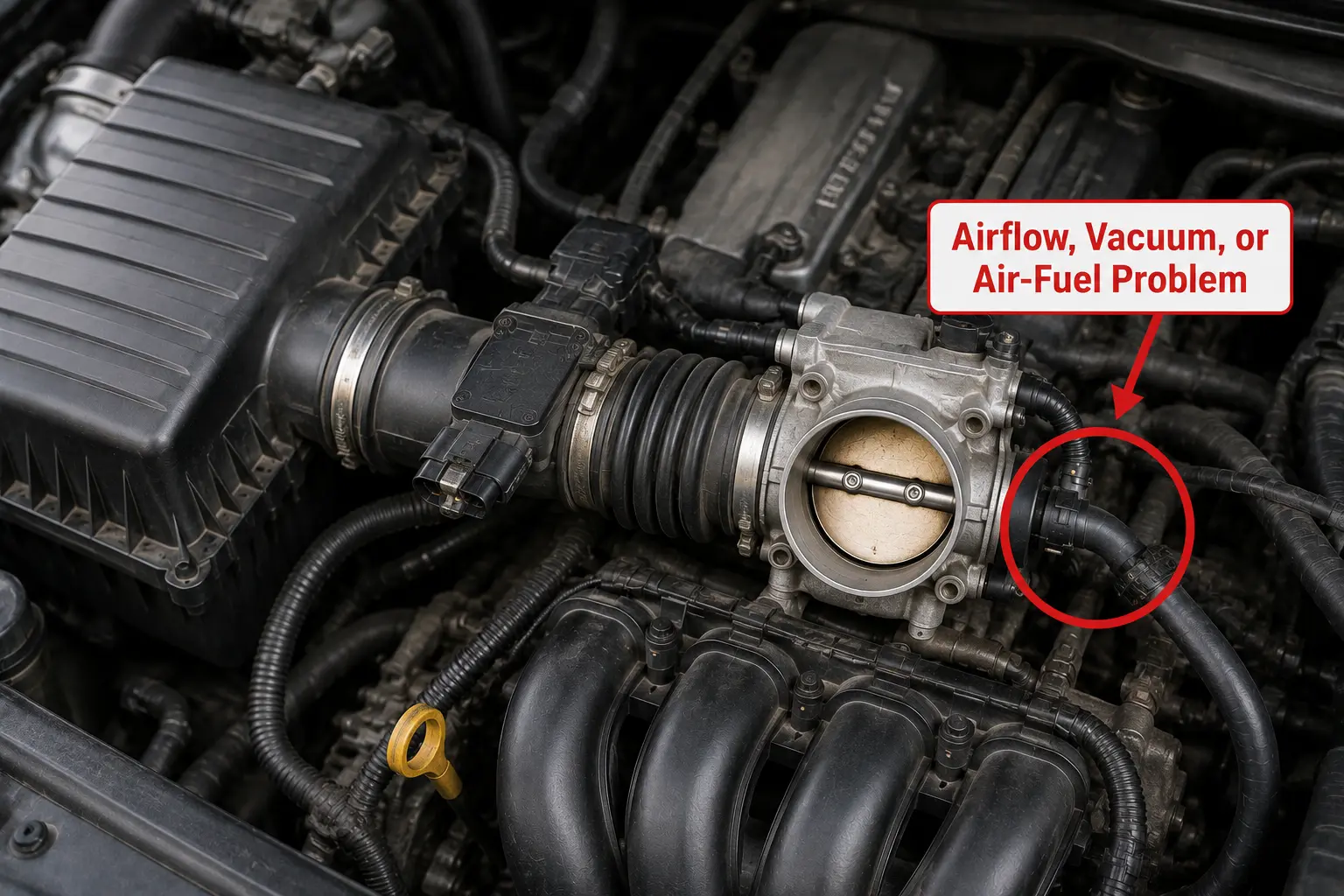
Problems with the amount of air entering the engine can also turn on the Check Engine Light.
Possible causes include a dirty or faulty mass airflow (MAF) sensor, cracked intake hose, vacuum leak, fuel-delivery issue, or another condition that causes the engine to run too lean or rich.
You may notice:
- Rough idle
- Hesitation
- Poor acceleration
- Engine surging
- Reduced fuel economy
Lean-condition codes such as P0171 or P0174 may be stored in some situations.
Because traction control depends partly on predictable engine torque, certain powertrain faults may cause the vehicle to disable the system until the engine problem is corrected.
What to do: Inspect the intake system for obvious loose hoses or damage and retrieve the codes. Proper diagnosis may require checking fuel trims, airflow readings, vacuum leaks, and fuel pressure rather than immediately replacing the MAF or oxygen sensors.
If the engine runs normally and the CEL is solid, short-distance driving may be possible. Rough running, severe hesitation, or a flashing warning requires greater caution.
5. Weak Battery or Charging-System Voltage
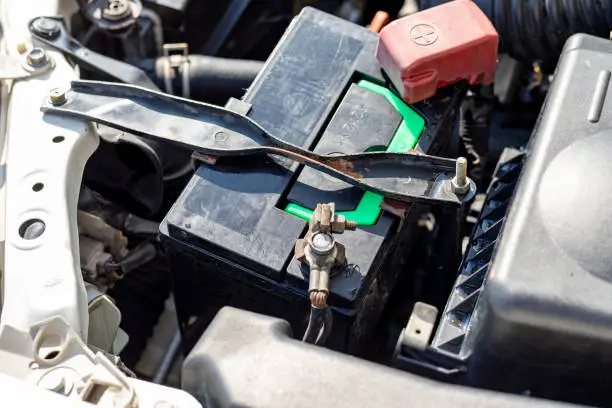
When the check engine light and traction control light came on together with several other warnings, electrical voltage deserves attention.
Modern control modules need stable electrical power. A weak battery, charging-system problem, loose battery terminal, poor ground, or damaged connection can interfere with module operation or communication.
Watch for other clues such as:
- Slow engine cranking
- Dim or flickering lights
- Multiple warnings appearing together
- Recent battery problems
- Electrical accessories behaving strangely
A failing alternator can make the problem more serious because the vehicle may eventually lose enough electrical power to keep running.
What to do: Check battery condition, terminals, grounds, and charging-system operation. Don’t assume the battery is bad simply because several dashboard lights appeared.
If the battery warning light is also illuminated while the engine is running, the charging system should be checked promptly.
6. Damaged Wiring or Control-Module Communication
Sometimes the components themselves are fine, but the information cannot travel correctly between them.
The ECM/PCM, ABS module, transmission controller, and stability-control system exchange information over the vehicle’s communication network, commonly called the CAN bus.
Damaged wiring, water intrusion, corrosion, poor grounds, loose connectors, or module faults can cause communication problems and multiple warning lights.
These faults can be harder to diagnose because symptoms may appear intermittently.
What to do: A capable scan tool should check all relevant modules for stored communication, powertrain, and chassis codes. Electrical testing may then be required to locate a bad circuit, ground, connector, or module.
Avoid replacing control modules until their power supplies, grounds, network circuits, and related components have been properly tested.
Can You Drive With the Traction Control and Check Engine Light On?
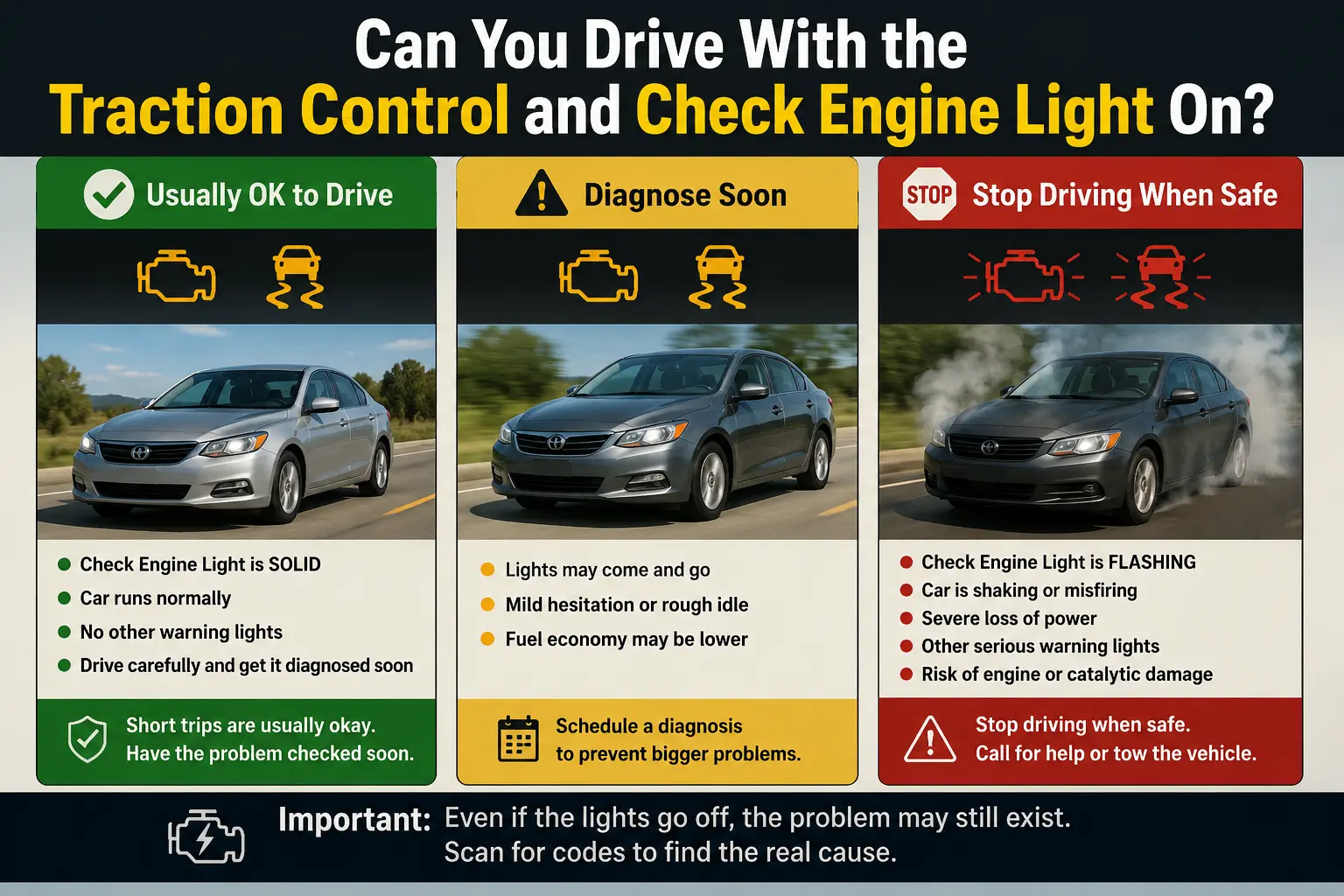
It depends on the warning behavior and how the vehicle is running.
You can usually drive carefully for a short distance for diagnosis if:
- The Check Engine Light is solid
- The engine runs normally
- Acceleration feels normal
- No temperature, oil-pressure, brake, or charging warnings are present
Remember that traction or stability assistance may be unavailable. Take extra care in rain, snow, ice, gravel, or other low-grip conditions.
Get the vehicle diagnosed soon if:
- Both lights remain on
- Traction control stays disabled
- The engine hesitates
- Fuel economy suddenly worsens
- Multiple warning lights appear
Stop driving when safely possible if:
- The Check Engine Light is flashing
- The engine is shaking severely
- The vehicle repeatedly stalls
- Acceleration becomes dangerously limited
- A low oil-pressure or overheating warning appears
A flashing Check Engine Light commonly indicates a more urgent fault than a steady warning, particularly when the engine is misfiring.
What to Do When Both Lights Come On
Don’t start by disconnecting the battery or clearing the codes. Doing that may remove information that helps identify the original problem.
Instead, use this troubleshooting order:
- Check how the engine runs. Note shaking, rough idle, hesitation, reduced power, stalling, or unusual noises.
- Check the other warning lights. ABS, battery, brake, temperature, or oil-pressure warnings can provide important clues.
- Connect an OBD-II scanner. Retrieve stored and pending DTCs. A more advanced scan tool may be required to read ABS, traction-control, and manufacturer-specific codes.
- Save the codes and freeze-frame data. Freeze-frame data shows operating conditions recorded when certain faults were detected and can help with diagnosis.
- Identify the affected system. A P0300 points you toward a misfire investigation, for example, while a throttle correlation code points toward electronic throttle diagnosis. A chassis code may direct attention toward an ABS or wheel-speed circuit.
- Test before replacing parts. A code identifies where the computer detected a problem. It does not always identify the failed component.
- Repair the root cause and confirm the repair. After the problem is corrected and codes are cleared or the required self-tests are completed, verify that the warnings do not return.
Will the Traction Control Light Go Off After Fixing the Engine Problem?
Often, it can.
If traction control was disabled only because the ECM/PCM detected an engine fault, repairing that fault may allow traction or stability control to operate normally again.
The lights may turn off after the codes are cleared and the vehicle completes the required system checks. If the warning remains after the underlying fault has been fixed, resetting the Check Engine Light with an OBD-II scanner may be appropriate.
If the traction control light remains on, however, there may be a separate ABS, wheel-speed sensor, steering/stability, wiring, or communication fault that still needs diagnosis.
The Bottom Line
When the check engine light and traction control light are on together, don’t assume you have two failed systems. An engine-management problem can cause traction or stability control to be temporarily disabled, while ABS, electrical, or communication faults can also create multiple warnings.
Start with the symptoms and stored DTCs. A solid Check Engine Light with normal engine operation usually gives you more time to arrange diagnosis, but you should drive cautiously if traction control is unavailable.
A flashing Check Engine Light, severe shaking, major power loss, overheating, or low oil pressure requires much more immediate attention.
Most importantly, diagnose the fault before replacing parts or resetting the lights. The warning lights tell you which systems detected a problem; proper testing tells you what actually failed.
FAQs
Why did my check engine and traction control lights come on at the same time?
An engine or electronic throttle fault can cause some vehicles to disable traction or stability control. Misfires, throttle-control problems, electrical faults, and ABS/wheel-speed issues are among the possible causes. Scan the vehicle for DTCs before replacing parts.
Can a bad wheel-speed sensor cause the traction control and Check Engine Light to come on?
A faulty wheel-speed sensor commonly affects ABS, traction control, and stability control. Whether it also triggers a Check Engine Light depends on the vehicle and fault. Retrieve codes from both the powertrain and ABS modules to determine which system detected the problem.
Why are the check engine light and traction control light on and my car is shaking?
Engine shaking with these warnings often points toward a significant engine-running problem, with a misfire being one possibility. If the Check Engine Light is flashing or the shaking is severe, stop driving when safe and have the vehicle diagnosed.
Can a weak battery cause the Check Engine Light and traction control light?
Low or unstable system voltage can cause multiple control modules to set faults or communicate incorrectly. Check the battery, terminals, grounds, and charging system, especially if several warning lights appeared together.