
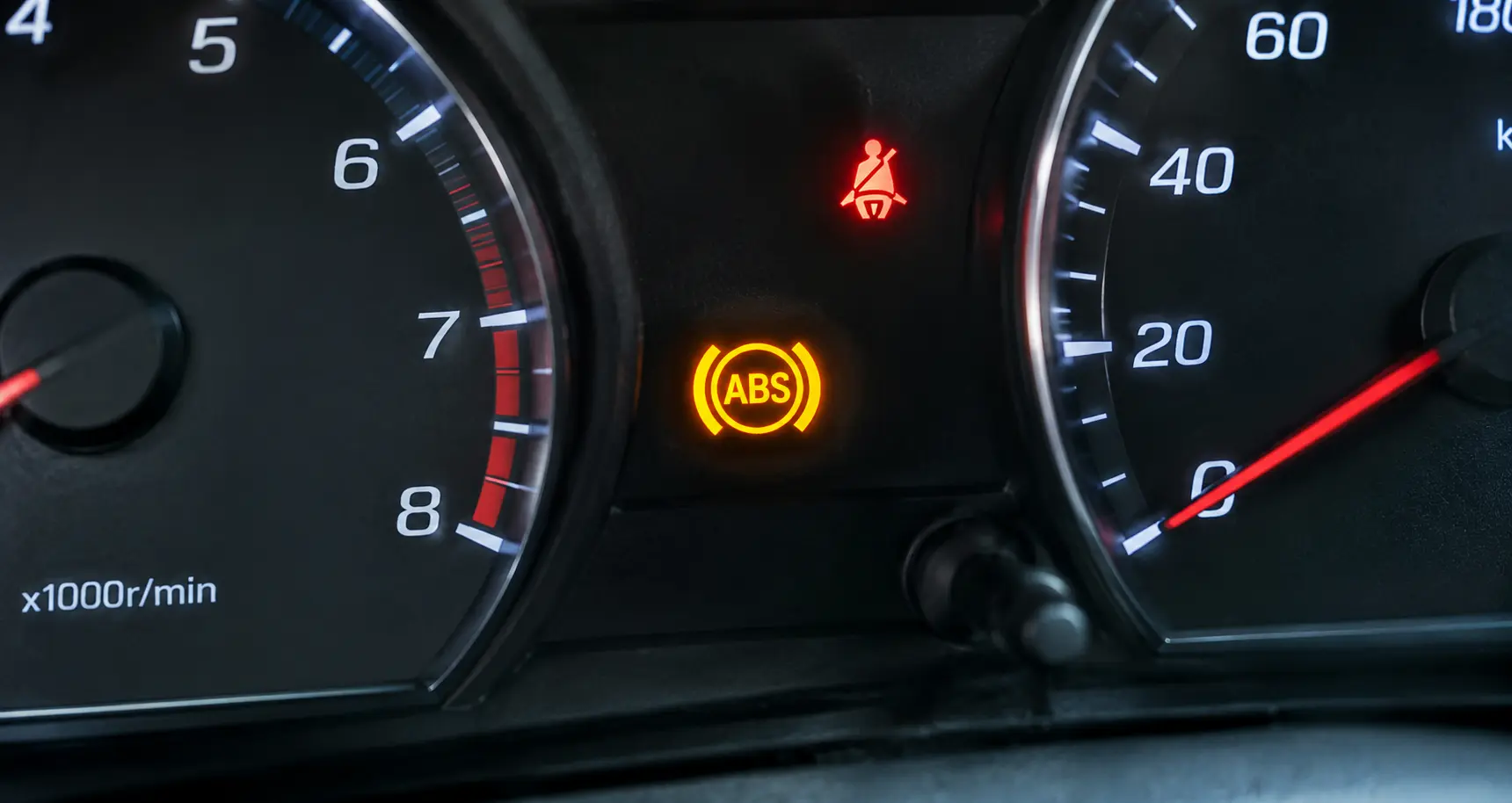
If your ABS warning light stays on after starting your car, the anti-lock braking system (ABS) has detected a fault. In many cases, your normal brakes will still work, but the ABS may not prevent the wheels from locking during emergency braking, reducing steering control on wet, icy, or slippery roads.
If only the amber ABS light is on and the brake pedal feels normal, you can usually drive carefully to a repair shop. However, if the red brake warning light is also on, the brake pedal feels soft, or you notice a brake fluid leak, stop driving as soon as it is safe because the problem may involve the main braking system.
Common causes include a faulty wheel speed sensor, damaged wiring, low brake fluid, a failed ABS control module, a hydraulic control unit problem, or a worn wheel bearing. This guide explains what the ABS warning light means, whether it is safe to drive, the most common causes, how the system is diagnosed, and the best way to fix the problem.
What Does the ABS Warning Light Mean?
The ABS warning light means the vehicle has detected a fault somewhere in the anti-lock braking system. The system stores a diagnostic trouble code and turns on the dashboard warning light to alert the driver that the ABS may no longer operate as designed.
This does not always mean your normal brakes have failed.
On many vehicles, you can still slow down and stop using the standard hydraulic braking system. However, without a working ABS, the wheels may lock during hard braking, making it harder to steer around obstacles.
Think of ABS as an extra layer of safety rather than the main braking system.
What Does ABS Stand For?
ABS stands for Anti-Lock Braking System.
Its job is to monitor how fast each wheel is turning using wheel speed sensors. If one or more wheels begin to lock during heavy braking, the ABS control module quickly adjusts hydraulic brake pressure through valves inside the hydraulic control unit. This helps the tires keep rolling instead of sliding.
Because the tires continue rotating, you have a better chance of maintaining steering control while braking.
Is It Normal for the ABS Light to Turn On When Starting the Car?
Yes.
When you switch the ignition on, most vehicles perform a quick self-test of several safety systems.
During this test, you may briefly see:
- ABS light
- Check Engine Light
- Battery warning light
- Oil pressure warning light
- Airbag light
If the ABS light turns off after a few seconds, the self-test completed successfully.
If it stays on after the engine starts or comes on while driving, the system has detected a fault that needs attention.
What Happens When the ABS Light Stays On?
When the light remains illuminated, the anti-lock braking function may be disabled until the problem is repaired.
Depending on the vehicle, you may notice:
- Anti-lock braking no longer works.
- Emergency braking performance is reduced on slippery roads.
- Stopping distance may increase on snow, ice, or wet pavement.
- Traction control or electronic stability control may also be limited because these systems often share wheel speed data.
The exact behavior depends on your vehicle’s make, model, and year.
What Should You Do When the ABS Light Comes On?
Seeing any warning light can be worrying, but your next steps should be based on how the vehicle behaves—not just the light itself.
Follow these steps.
1. Check Whether the Red Brake Warning Light Is Also On
This is the most important first check.
If only the amber ABS light is on, the problem is often limited to the anti-lock braking system.
If the ABS light and the red brake warning light are both illuminated, the issue may involve:
- Low brake fluid
- A hydraulic brake problem
- A brake fluid leak
- Reduced braking performance
In this situation, do not ignore the warning.
2. Pay Attention to the Brake Pedal
Ask yourself these questions:
- Does the brake pedal feel normal?
- Does it feel soft or spongy?
- Does it sink toward the floor?
- Does the vehicle pull to one side while braking?
If braking feels different than usual, avoid continuing your journey until the problem has been inspected.
3. Listen for Unusual Noises
Some ABS faults are accompanied by other symptoms.
You may hear:
- Grinding noises
- Humming from a wheel bearing
- Clicking near a wheel
- Buzzing from the ABS hydraulic unit
These sounds can help narrow down the cause during diagnosis.
4. Look for Obvious Problems
If it is safe, perform a quick visual inspection.
Check for:
- Low brake fluid in the reservoir
- Fluid leaking under the vehicle
- Damaged wiring near the wheels
- Loose electrical connectors
- Obvious damage after hitting a pothole or curb
You should never remove brake components unless you know how to do so safely.
5. Avoid Hard Braking
If the ABS is not working properly, avoid situations that require emergency braking whenever possible.
Drive carefully by:
- Leaving extra space between vehicles
- Reducing speed
- Avoiding sudden braking
- Being especially cautious in rain, snow, or icy conditions
6. Schedule a Proper Diagnosis
Many drivers assume any code reader can diagnose the ABS.
That is not true.
A basic OBD-II scanner often reads only engine and emissions codes. Many vehicles require an ABS-capable diagnostic scanner that can communicate with the brake control module and retrieve chassis fault codes.
Without the correct equipment, replacing parts becomes guesswork.
Is It Safe to Drive With the ABS Light On?
The answer depends on what other symptoms are present.
There is no single answer that applies to every vehicle.
When Only the ABS Light Is On
If:
- Only the amber ABS light is illuminated
- The brake pedal feels normal
- There are no unusual noises
- No red brake warning light is present
Your standard brakes will often continue working.
However, the anti-lock braking function may not activate during emergency stops.
That means the vehicle could:
- Skid more easily
- Lose steering control during hard braking
- Require a longer stopping distance on slippery roads
You should still have the system inspected as soon as practical.
When the ABS and Brake Warning Lights Are Both On
This combination deserves much more attention.
It can indicate:
- Low brake fluid
- Hydraulic pressure problems
- Brake system leaks
- A fault affecting normal braking
If braking performance changes or the pedal feels soft, stop driving and arrange professional assistance.
When the ABS and Traction Control Lights Are On Together
Many modern vehicles share information between:
- ABS
- Traction Control System (TCS)
- Electronic Stability Control (ESC)
A failed wheel speed sensor or damaged wiring can trigger multiple warning lights at the same time.
The vehicle may still drive normally on dry roads, but traction and stability systems may not respond correctly during sudden maneuvers or poor weather.
ABS Warning Light Situations at a Glance
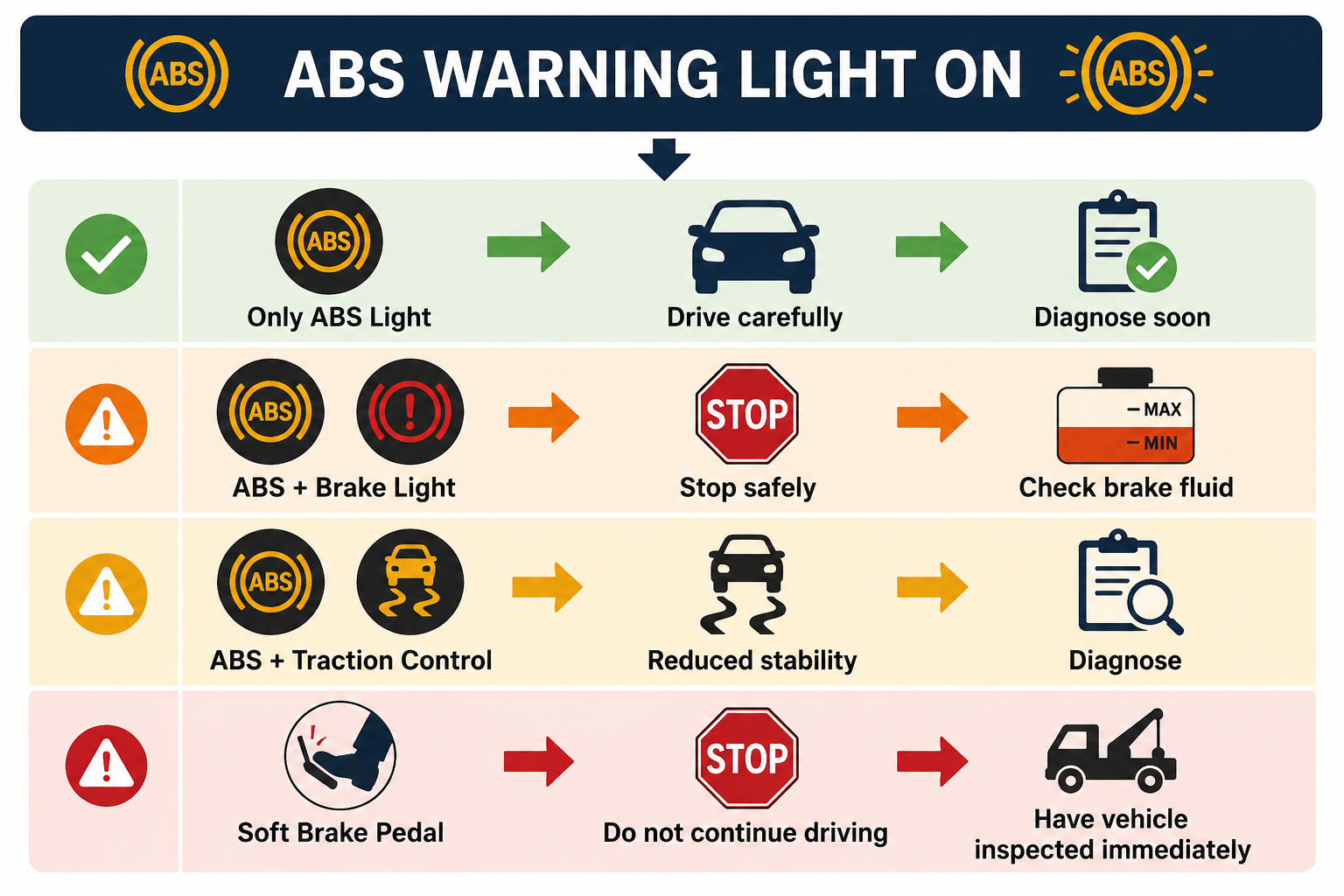
| Situation | What It Usually Means | Recommended Action |
| ABS light turns on briefly at startup | Normal self-test | No action needed if it turns off |
| ABS light stays on | ABS fault detected | Drive carefully and schedule diagnosis |
| ABS and traction control lights on | Shared sensor or control system problem | Avoid slippery roads and have the vehicle scanned |
| ABS and red brake warning lights on | Possible brake system or hydraulic fault | Stop safely and inspect immediately |
| ABS light comes on after hitting a pothole | Possible sensor, wiring, or wheel bearing damage | Inspect and perform an ABS scan |
How the Anti-Lock Braking System Works
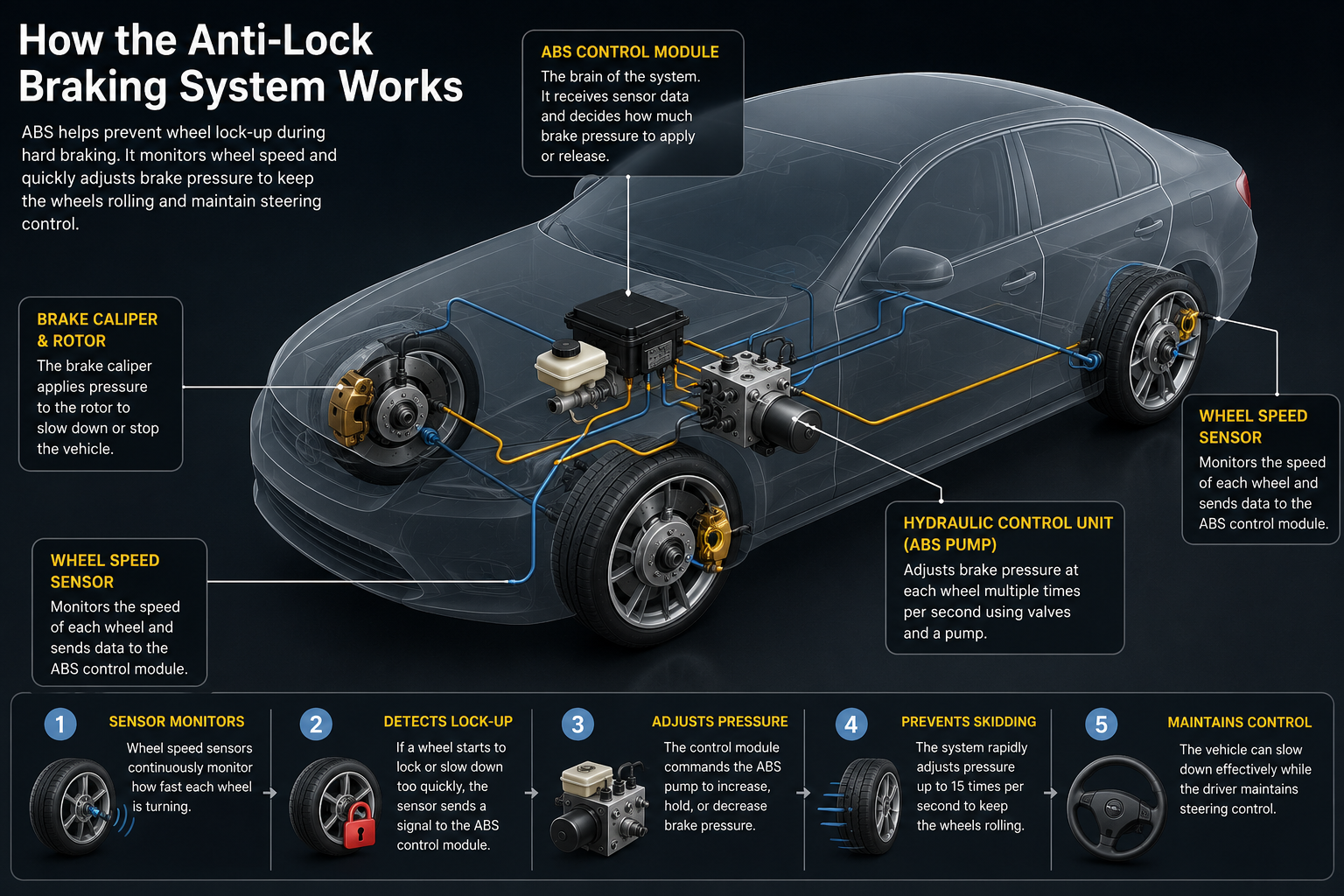
The anti-lock braking system (ABS) helps prevent the wheels from locking during hard braking, allowing you to maintain better steering control and traction.
The main components include:
- Wheel speed sensors
- ABS control module
- Hydraulic control unit
- Pump motor
- Solenoid valves
- Tone rings, or magnetic encoder rings
The wheel speed sensors continuously monitor how fast each wheel is turning and send that information to the ABS control module. If the module detects that a wheel is about to lock, it commands the hydraulic control unit to quickly adjust brake pressure using the pump motor and solenoid valves.
This process happens many times per second, helping the tires maintain grip instead of skidding. During hard braking, you may feel the brake pedal pulse. This is a normal sign that the ABS is actively working to help maintain vehicle control.
Common Causes of an ABS Warning Light
An ABS warning light does not point to one specific problem. Instead, it tells you that the anti-lock braking system has detected a fault somewhere in the system. The only way to know the exact cause is to read the stored ABS diagnostic trouble codes and inspect the affected components.
Below are the most common reasons an ABS light comes on and what each one means.
1. Dirty or Faulty Wheel Speed Sensor
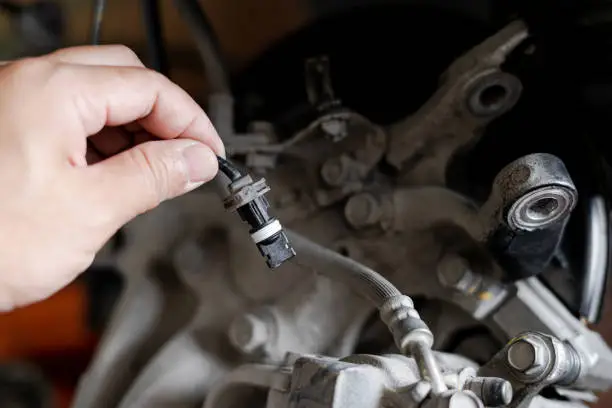
A wheel speed sensor is the most common cause of an ABS warning light.
Every wheel has a sensor that monitors how fast it is rotating. These sensors constantly send data to the ABS control module, which compares the speed of all four wheels. If one sensor sends incorrect or missing information, the module can no longer calculate wheel speed accurately, so it turns on the ABS warning light.
Wheel speed sensors work in a harsh environment. They are exposed to:
- Water
- Mud
- Road salt
- Dust
- Small rocks
- Metal particles
- Heat from the brakes
Over time, dirt can collect on the sensor tip, reducing its ability to read the tone ring or magnetic encoder correctly. The sensor itself can also fail due to age or physical damage.
Common symptoms
- ABS warning light stays on
- ABS and traction control lights appear together
- ABS activates unexpectedly at very low speeds
- Cruise control may stop working on some vehicles
How it’s diagnosed
A technician uses an ABS-capable scan tool to identify which wheel is reporting incorrect speed data. Live wheel-speed readings can then be compared while driving or while the wheels are spinning on a lift.
Typical repair
Depending on the problem, the repair may involve:
- Cleaning the sensor
- Repairing the wiring
- Replacing the wheel speed sensor
2. Damaged Sensor Wiring or Corroded Electrical Connectors
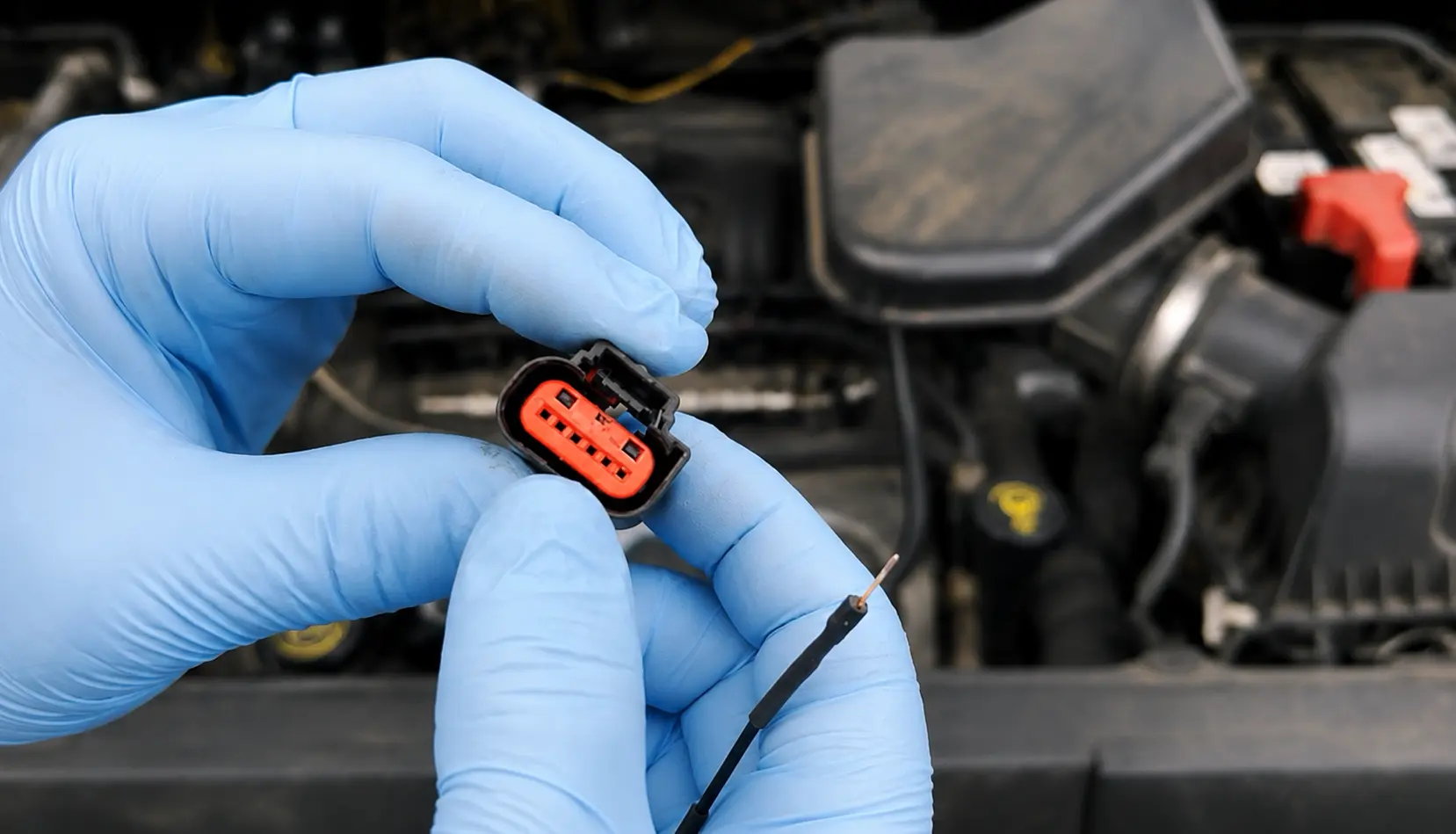
Sometimes the sensor is perfectly good, but the wiring connecting it to the ABS module is damaged.
The wiring harness near each wheel moves every time the suspension travels. Years of vibration, road debris, moisture, and heat can eventually damage the insulation or break wires inside the harness.
Corrosion inside electrical connectors is another common problem, especially in areas that experience rain, snow, or road salt.
Even a small interruption in the electrical signal can cause the ABS module to lose communication with the sensor.
Common symptoms
- Intermittent ABS warning light
- Light comes on while turning
- Warning appears after driving through water
- Multiple warning lights appear randomly
How it’s diagnosed
The technician performs:
- Visual inspection
- Connector inspection
- Wiring continuity test
- Voltage test
- Live sensor signal comparison
Typical repair
Repairs may include:
- Cleaning corroded terminals
- Repairing damaged wires
- Replacing the connector
- Installing a new wiring harness
3. Cracked or Rusted Tone Ring
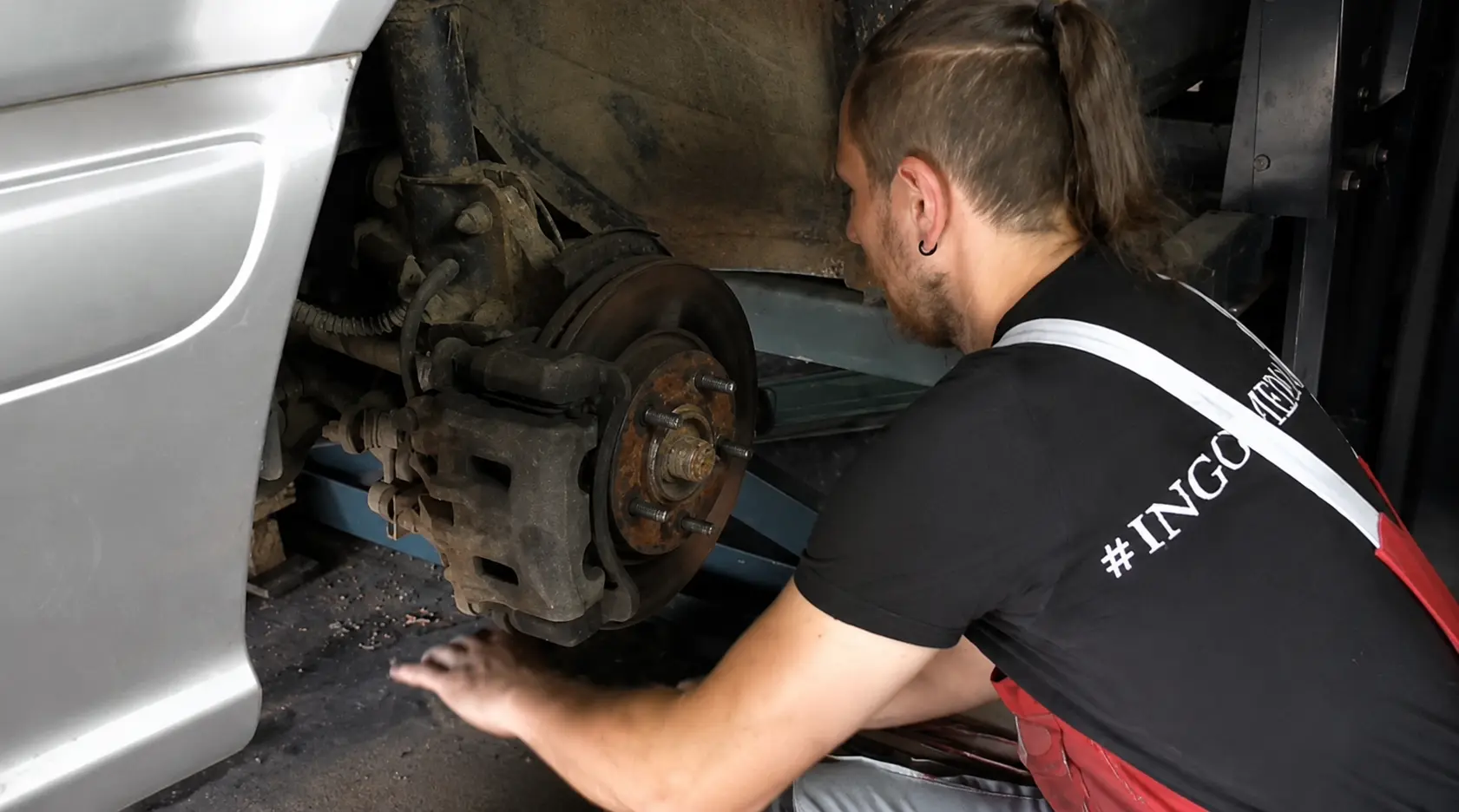
Many vehicles use a tone ring, also called a reluctor ring, to help the wheel speed sensor measure wheel rotation.
The ring contains evenly spaced teeth that pass by the sensor as the wheel turns. The ABS module converts this signal into wheel-speed information.
Over time, the ring may develop:
- Rust
- Cracks
- Broken teeth
- Dirt buildup
Even one damaged section can create an incorrect speed signal.
Some newer vehicles use a magnetic encoder ring built into the wheel bearing instead of a visible toothed ring. If this encoder is damaged or installed incorrectly, the ABS warning light may appear.
Common symptoms
- ABS activates unexpectedly
- ABS warning light comes and goes
- Pulsing brake pedal at low speed
- Traction control warning light
How it’s diagnosed
Technicians inspect the ring while checking the wheel hub and compare wheel-speed signals using live data.
Typical repair
Repair usually involves replacing:
- The damaged tone ring
- The wheel bearing if the encoder is built into the bearing
4. Low Brake Fluid
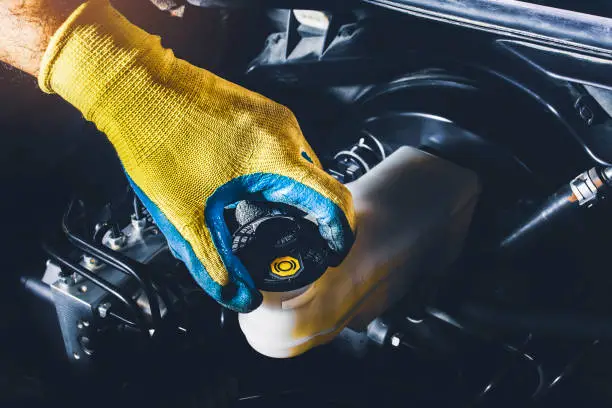
Low brake fluid is another common reason for brake-related warning lights.
The anti-lock braking system depends on proper hydraulic pressure to control braking force. If the brake fluid level becomes too low, the system may not operate correctly.
Brake fluid normally does not disappear.
A low level usually points to:
- Brake pad wear
- A hydraulic leak
- Damaged brake lines
- Leaking brake calipers
- A leaking master cylinder
Common symptoms
- ABS warning light
- Red brake warning light
- Soft brake pedal
- Reduced braking performance
How it’s diagnosed
The technician checks:
- Brake fluid reservoir
- Brake lines
- Calipers
- Flexible brake hoses
- Master cylinder
- Wheel cylinders where applicable
Typical repair
The solution depends on the cause.
Simply topping off the reservoir without repairing the leak is only a temporary fix.
5. Blown ABS Fuse or Faulty Relay
Like many electrical systems, the ABS is protected by one or more fuses and relays.
If a fuse blows, electrical power to the ABS module or hydraulic pump may be interrupted.
A blown fuse is often the result of:
- Electrical short circuit
- Internal component failure
- Wiring damage
- Excessive current draw
Common symptoms
- ABS warning light appears suddenly
- No communication with the ABS module
- ABS pump does not operate
How it’s diagnosed
The technician checks:
- Fuse condition
- Relay operation
- Power supply
- Ground connections
Typical repair
Repairs may include replacing the failed fuse or relay, but the underlying electrical problem must also be corrected.
6. Faulty ABS Control Module
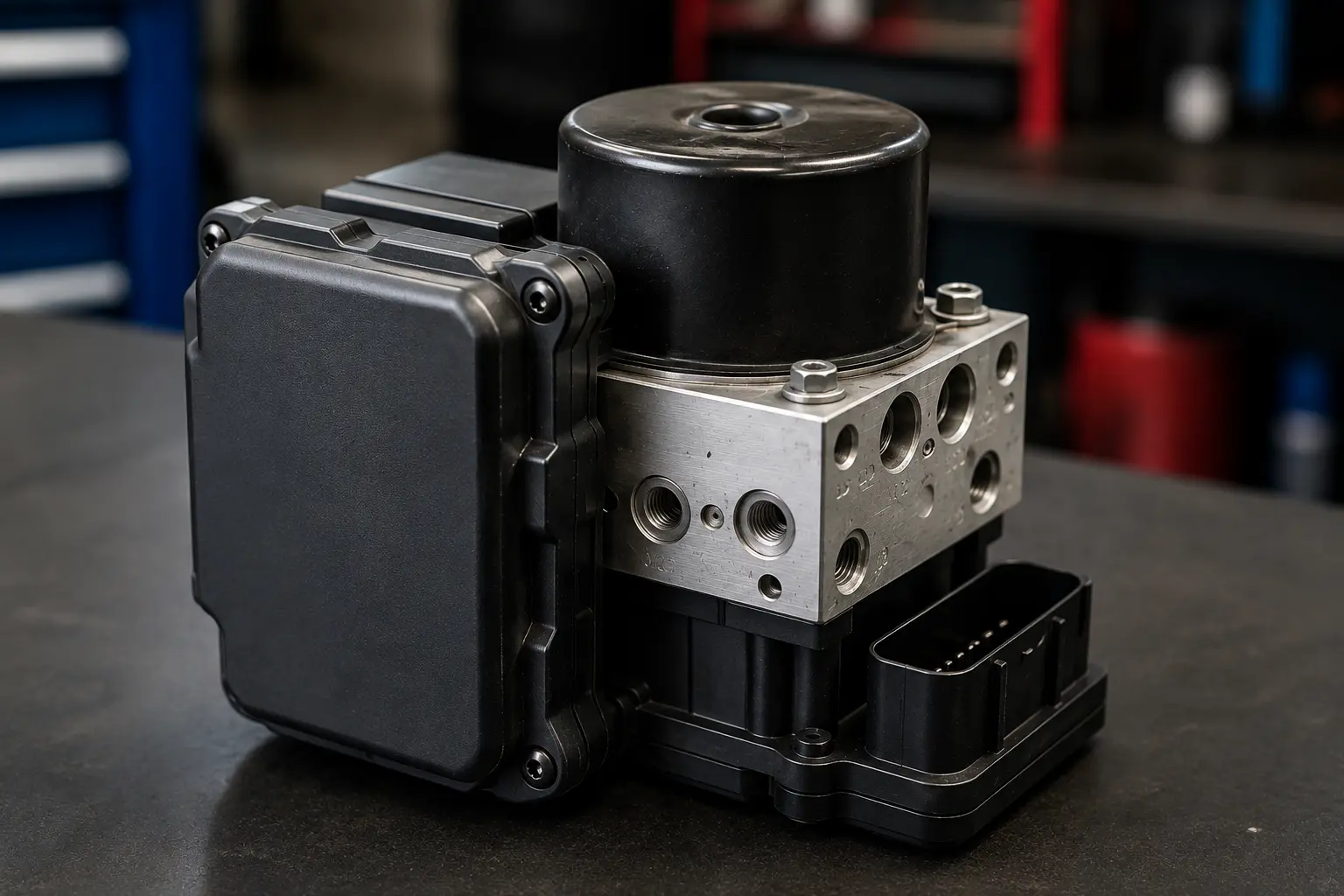
The ABS control module acts as the brain of the anti-lock braking system.
It receives information from the wheel speed sensors and decides when to increase or decrease brake pressure.
Although control modules are generally reliable, they can fail due to:
- Moisture intrusion
- Internal electrical faults
- Heat damage
- Corrosion
- Age
- Manufacturing defects
A failed module may also prevent communication with diagnostic equipment.
Common symptoms
- ABS warning light remains on
- Multiple brake-related warning lights
- Communication fault codes
- Intermittent ABS operation
How it’s diagnosed
Diagnosis may include:
- Module communication tests
- Power and ground checks
- Wiring inspection
- Software verification
- Scan tool communication testing
Typical repair
Depending on the vehicle, the module may require:
- Software update
- Repair
- Replacement
- Programming after installation
7. Failed Hydraulic Control Unit or ABS Pump
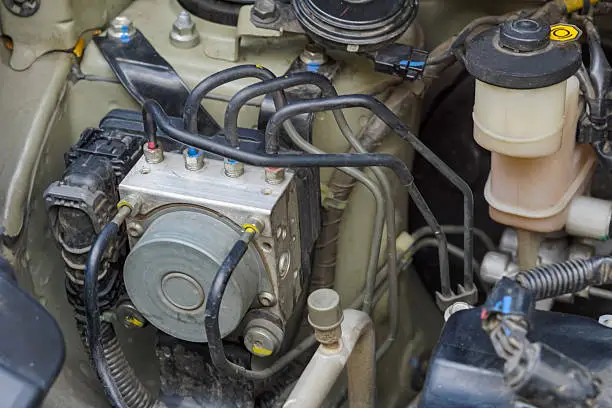
The hydraulic control unit contains valves and a pump that regulate brake pressure whenever the ABS activates.
During emergency braking, this unit rapidly increases and decreases hydraulic pressure to prevent wheel lock.
If the hydraulic pump fails, or if one of the internal solenoid valves sticks, the ABS may shut down completely.
Possible causes include:
- Internal wear
- Electrical failure
- Brake fluid contamination
- Moisture
- Corrosion
Common symptoms
- ABS warning light
- Unusual buzzing from the hydraulic unit
- ABS no longer activates during hard braking
- Stored pump motor fault codes
How it’s diagnosed
The technician uses an advanced scan tool to:
- Activate the pump
- Test valve operation
- Check hydraulic pressure
- Read pump-related fault codes
Typical repair
Depending on the failure, the hydraulic control unit or pump assembly may need to be repaired or replaced.
8. Worn Wheel Bearing or Hub Assembly
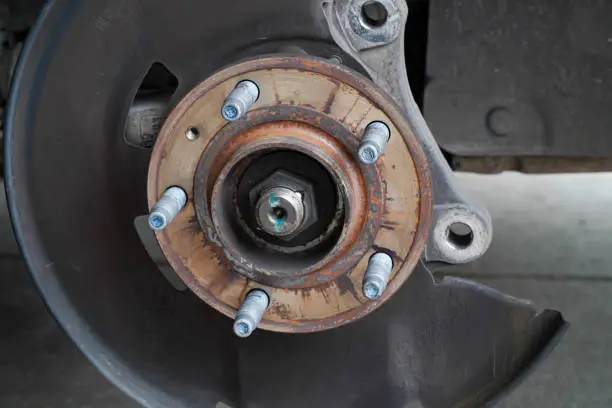
Many drivers do not realize that a wheel bearing can also trigger an ABS warning light.
On many vehicles, the wheel bearing contains the magnetic encoder that the wheel speed sensor reads.
As the bearing wears, excessive movement can affect the sensor signal.
A damaged hub assembly may also change the gap between the sensor and encoder, causing inaccurate wheel-speed readings.
Common symptoms
- ABS warning light
- Humming or growling noise from one wheel
- Vibration while driving
- Intermittent wheel-speed sensor codes
How it’s diagnosed
The technician checks for:
- Bearing play
- Wheel movement
- Bearing noise
- Live wheel-speed readings
Typical repair
If the bearing is worn, replacing the complete wheel hub or bearing assembly usually solves both the mechanical problem and the ABS fault.
9. Weak Battery or Charging-System Problems
The anti-lock braking system depends on a stable electrical supply.
If the battery is weak or the alternator is not charging properly, system voltage can fall below the level required for reliable ABS operation.
Low voltage can trigger warning lights even when the brake components themselves are working normally.
This situation is more common after:
- Battery replacement
- Jump-starting the vehicle
- Alternator failure
- Long periods without driving
Common symptoms
- ABS warning light appears after starting
- Multiple dashboard warning lights
- Slow engine cranking
- Battery warning light also illuminated
How it’s diagnosed
The charging system is tested by checking:
- Battery condition
- Charging voltage
- Ground connections
- Alternator output
Typical repair
Depending on the test results, the repair may involve charging or replacing the battery, repairing electrical connections, or replacing a faulty alternator. After restoring proper voltage, stored ABS fault codes can be cleared, and the system retested.
What Different ABS Light Behaviors Mean
The way your ABS warning light behaves can help identify the problem. While an ABS-capable scan tool is needed to confirm the fault, these warning patterns provide useful clues.
ABS Light Turns On at Startup and Goes Off
This is normal. The vehicle performs a quick self-test of the anti-lock braking system (ABS) and other safety systems when you start the engine. If the light turns off after a few seconds, no repair is needed.
ABS Light Stays On
A solid ABS warning light usually means the anti-lock braking system has detected a fault and disabled ABS. Common causes include a faulty wheel speed sensor, damaged wiring, a failed ABS control module, low system voltage, or a hydraulic control unit problem. Although your regular brakes may still work, have the system diagnosed as soon as possible.
ABS Light Comes On and Goes Off
An intermittent ABS light often points to a loose electrical connector, damaged wiring, a failing wheel speed sensor, a worn wheel bearing, or a cracked tone ring. These faults may only appear while turning, after hitting a pothole, or in wet weather. Even if the light goes out, the ABS module usually stores a fault code for diagnosis.
Flashing or Blinking ABS Light
A flashing ABS light can indicate an active fault or communication problem on some vehicles. Because warning-light behavior varies by manufacturer, reduce your speed and have the vehicle inspected as soon as possible.
ABS Light Comes On While Driving or After Rain
If the warning appears only after the vehicle starts moving, after driving through rain, or after a car wash, the cause may be a damaged wheel speed sensor, moisture inside an electrical connector, a cracked magnetic encoder or tone ring, or damaged sensor wiring. Even if the light disappears, the system should still be inspected because the fault is likely to return.
Why Are the ABS and Traction Control Lights On Together?
Many drivers notice both the ABS warning light and the traction control light turning on at the same time.
This is very common.
Modern vehicles often share information between several safety systems, including:
- Anti-lock Braking System (ABS)
- Traction Control System (TCS)
- Electronic Stability Control (ESC)
- Vehicle Stability Control (VSC)
- StabiliTrak (GM vehicles)
- Dynamic Stability Control (DSC) on some manufacturers
All of these systems rely heavily on accurate wheel-speed information.
If the ABS cannot determine how fast each wheel is turning, the traction and stability systems may also stop working correctly.
Common causes
- Failed wheel speed sensor
- Damaged sensor wiring
- Corroded electrical connector
- Faulty steering-angle sensor
- Failed ABS control module
- Wheel bearing affecting sensor readings
- Low battery voltage
What you may notice
- Traction control disabled
- Stability control unavailable
- Reduced grip on slippery roads
- Multiple dashboard warning lights
On dry roads, you may not notice much difference during normal driving.
However, during heavy rain, snow, or emergency maneuvers, these safety systems may not be available to help maintain vehicle control.
Why Are the ABS and Red Brake Warning Lights On Together?
This combination should never be ignored.
Unlike an ABS warning light by itself, the red brake warning light may indicate a problem affecting the primary braking system.
Possible causes include:
- Low brake fluid
- Brake fluid leak
- Hydraulic pressure problem
- Parking brake switch fault
- Master cylinder problem
- Brake system malfunction
If you notice both lights together, ask yourself these questions:
- Does the brake pedal feel soft?
- Is the pedal traveling farther than normal?
- Is braking performance reduced?
- Is there brake fluid leaking under the vehicle?
If the answer to any of these is yes, stop driving as soon as it is safe and arrange professional assistance.
Ignoring a hydraulic brake problem can significantly reduce your ability to stop the vehicle safely.
ABS Light After Maintenance or Repairs
An ABS warning light sometimes appears after routine maintenance. In many cases, this does not mean a new part has failed. Instead, a sensor, wiring harness, or electrical connector may have been disturbed during the repair.
After Brake Service
Replacing brake pads or rotors requires working around the wheel speed sensor. A stretched wire, loose connector, pinched harness, or dirt near the sensor can trigger the ABS light. If the warning appears immediately after brake work, inspect these areas before replacing the sensor.
After Wheel, Tire, or Suspension Repairs
Wheel bearing, hub, tire, and suspension work can all affect ABS operation. A damaged magnetic encoder, incorrect wheel bearing installation, mismatched tire sizes, loose connectors, or damaged sensor wiring may cause inaccurate wheel-speed readings and turn on the ABS warning light.
After Battery Replacement
A weak battery, low system voltage, poor battery connections, or stored fault codes can sometimes trigger the ABS warning light after a battery replacement. In many cases, the light clears once the electrical system is working properly and the fault codes are erased.
Symptoms That May Appear With an ABS Warning Light
The warning light is not always the only symptom.
Depending on the underlying fault, you may also notice:
- Unexpected brake pedal pulsation
- Wheels locking during hard braking
- Longer stopping distances on wet roads
- Traction control no longer working
- Electronic stability control disabled
- Cruise control becoming unavailable on some vehicles
- Humming or growling from a worn wheel bearing
- Grinding noise near one wheel
- Multiple dashboard warning lights
- Intermittent warning lights during turns
- Speedometer problems on certain vehicles
Not every symptom will appear on every vehicle, but noticing these changes can help narrow down the cause during diagnosis.
How Mechanics Diagnose an ABS Warning Light
Diagnosing an ABS warning light starts with identifying the exact fault instead of replacing parts by guesswork.
1. Scan for ABS Trouble Codes
A technician uses an ABS-capable scan tool to read stored fault codes and identify the affected system or wheel.
2. Inspect the Components
Next, the technician checks the wheel speed sensors, wiring, electrical connectors, tone rings, wheel bearings, and brake fluid level for signs of damage or wear.
3. Test Related Systems
If needed, the battery, charging system, and ABS control module are tested to rule out electrical or communication problems.
After the faulty component is repaired, the ABS codes are cleared, and the vehicle is road-tested to confirm the warning light does not return.
How Mechanics Diagnose an ABS Warning Light
Finding the real cause of an ABS warning light involves much more than replacing the first part mentioned by a fault code.
Professional diagnosis usually follows a logical process.
Step 1: Confirm the Warning Lights
The technician notes whether the vehicle also displays:
- Brake warning light
- Traction control light
- Stability control warning
- Check Engine Light
This helps determine whether multiple systems are involved.
Step 2: Read ABS-Specific Trouble Codes
A professional scan tool communicates directly with the ABS control module to retrieve stored chassis diagnostic trouble codes (DTCs).
Unlike many basic code readers, an ABS-capable scanner can also display live wheel-speed data, helping identify which wheel or component is causing the fault.
Step 3: Inspect Sensors and Wiring
The next step is a visual inspection of:
- Wheel speed sensors
- Wiring harnesses
- Electrical connectors
- Tone rings or magnetic encoders
- Wheel bearings
The technician looks for corrosion, broken wires, damaged insulation, loose connectors, and signs of impact damage.
Step 4: Test Related Systems
If necessary, additional checks may include:
- Battery voltage
- Alternator charging output
- Brake fluid level
- Hydraulic control unit operation
- Communication between control modules
Once the fault has been repaired, the stored codes are cleared, and the vehicle is road-tested to confirm that the ABS warning light does not return.
Can You Reset the ABS Warning Light?
Many drivers search for a quick way to reset the ABS warning light.
However, resetting the light does not repair the underlying problem.
If the original fault still exists, the warning light will usually return as soon as the ABS performs another self-test.
Will Restarting the Vehicle Turn the Light Off?
Sometimes.
If the warning was caused by a temporary low-voltage condition or a brief communication error, restarting the vehicle may turn the light off.
However, if a component has actually failed, the warning light will normally come back.
Will Disconnecting the Battery Reset the ABS Light?
Disconnecting the battery may clear some stored information on certain vehicles, but it is not a proper repair method.
Many modern vehicles store ABS fault codes in non-volatile memory, meaning the codes remain even after battery power is removed.
Even if the light disappears temporarily, it will usually return if the original fault is still present.
Can an OBD-II Scanner Clear the ABS Light?
Only if the scanner supports the anti-lock braking system.
Many inexpensive code readers only communicate with the engine control module.
A professional ABS scan tool can:
- Read ABS fault codes
- Display live wheel-speed data
- Clear stored ABS codes after repairs
- Perform system tests on some vehicles
Always repair the problem before clearing the codes. Otherwise, the warning light will likely return during the next drive.
ABS Warning Light Repair Costs
Repair costs vary depending on:
- Vehicle make and model
- Parts prices
- Labor rates
- The failed component
- Whether genuine or aftermarket parts are used
The table below provides approximate repair ranges in the United States.
| Problem | Typical Repair | Estimated Cost (USD) |
| Dirty wheel speed sensor | Clean sensor | $50–$150 |
| Failed wheel speed sensor | Replace sensor | $150–$350 |
| Damaged wiring | Repair wiring or connector | $100–$400 |
| Blown fuse or relay | Replace electrical component | $50–$150 |
| Low brake fluid | Repair leak and refill fluid | $150–$600+ |
| Wheel bearing or hub assembly | Replace bearing or hub | $250–$700 |
| ABS control module | Repair or replace module | $400–$1,200+ |
| Hydraulic control unit or ABS pump | Replace hydraulic assembly | $800–$2,000+ |
| Steering-angle sensor calibration | Calibrate or replace sensor | $100–$500 |
These figures are only estimates.
Luxury vehicles and vehicles with integrated electronic brake systems may cost significantly more to repair.
How to Help Prevent ABS Problems
Not every ABS failure can be prevented, but regular maintenance can reduce the risk of unexpected warning lights.
Here are several good habits that help keep the system working properly.
Check Brake Fluid Regularly
Brake fluid should always remain between the minimum and maximum marks on the reservoir.
If the level drops repeatedly, have the braking system inspected for leaks instead of simply adding more fluid.
Replace Worn Wheel Bearings Promptly
A noisy or loose wheel bearing can eventually affect wheel-speed sensor readings.
Replacing a worn bearing early may prevent more expensive ABS repairs later.
Maintain Proper Tire Pressure
Keeping all tires inflated to the manufacturer’s recommended pressure helps maintain predictable wheel-speed readings.
Also avoid mixing tires with significantly different diameters unless specifically approved for your vehicle.
Protect Wheel-Speed Sensor Wiring
Whenever brake, suspension, or wheel work is performed, inspect the wiring near each wheel.
A stretched or pinched harness can easily trigger an ABS warning light.
Follow Brake Fluid Service Intervals
Brake fluid absorbs moisture over time.
Replacing the fluid according to your vehicle manufacturer’s maintenance schedule helps protect hydraulic components from corrosion.
Address Warning Lights Early
Many ABS problems begin as small electrical faults.
Ignoring the warning light may allow additional issues to develop, resulting in more expensive repairs.
Final Takeaway
An ABS warning light is an early warning that something in your vehicle’s braking system needs attention. In many cases, the problem is minor, but ignoring it can affect your safety when you need maximum braking control.
The sooner you identify the cause, the easier and often less expensive the repair will be. If you’re unsure why the light is on, avoid guessing or replacing parts at random. A proper inspection and an ABS-capable scan tool can quickly identify the fault and help restore the system to normal operation.
By understanding what the ABS warning light means and responding to it promptly, you can help keep your vehicle safer and avoid more costly repairs down the road.
Frequently Asked Questions
Can Low Brake Fluid Cause the ABS Warning Light?
Yes. Low brake fluid can reduce hydraulic pressure and may trigger the ABS warning light on some vehicles. It may also illuminate the red brake warning light, especially if there is a leak or another braking system problem.
Can Worn Brake Pads Turn On the ABS Warning Light?
Not directly. However, severely worn brake pads can lower the brake fluid level, which may contribute to brake-related warning lights on some vehicles.
Can a Weak Battery Cause the ABS Warning Light?
Yes. The anti-lock braking system (ABS) relies on stable electrical voltage. A weak battery or charging system problem can cause communication errors and trigger the ABS warning light.
Can Low Tire Pressure Cause the ABS Warning Light?
Low tire pressure alone usually will not turn on the ABS warning light. However, mismatched tire sizes or significant differences in tire circumference can affect wheel-speed readings on some vehicles.
How Do I Know Which ABS Sensor Is Bad?
The most accurate method is using an ABS-capable scan tool. It can identify which wheel speed sensor is reporting incorrect data, allowing the technician to inspect the sensor, wiring, and related components.
Why Is My ABS Light On but the Brakes Feel Normal?
This is common. Your standard hydraulic brakes may continue working even though the anti-lock braking system has been disabled. However, the vehicle should still be diagnosed because emergency braking performance may be reduced.
Why Did My ABS Light Come On After Hitting a Pothole?
A hard impact can damage a wheel speed sensor, wiring harness, electrical connector, wheel bearing, or tone ring. If the warning appears immediately after hitting a pothole or curb, inspect the affected wheel area as soon as possible.
Can an ABS Fault Affect the Speedometer?
Yes, on some vehicles. Certain models share wheel-speed data between the ABS, speedometer, transmission, and other control modules. A faulty wheel speed sensor may therefore affect more than one system.
Can an ABS Problem Affect the Transmission?
Yes, on some vehicles. The transmission control module may use wheel-speed information for shift timing. Incorrect speed data can contribute to harsh or delayed shifting.
Will the ABS Warning Light Fail a Vehicle Inspection?
It depends on your location. Some states may fail a vehicle if important safety-system warning lights remain illuminated. Check your local inspection requirements for specific regulations.
Can I Drive in Rain or Snow With the ABS Light On?
You should drive with extra caution. Without a functioning anti-lock braking system, the wheels are more likely to lock during hard braking, increasing stopping distance and reducing steering control on slippery roads.